
WAS THERE AN ISLAMIC MIDDLE AGES? A Conversation Between Hussein Fancy and Wendy Shaw
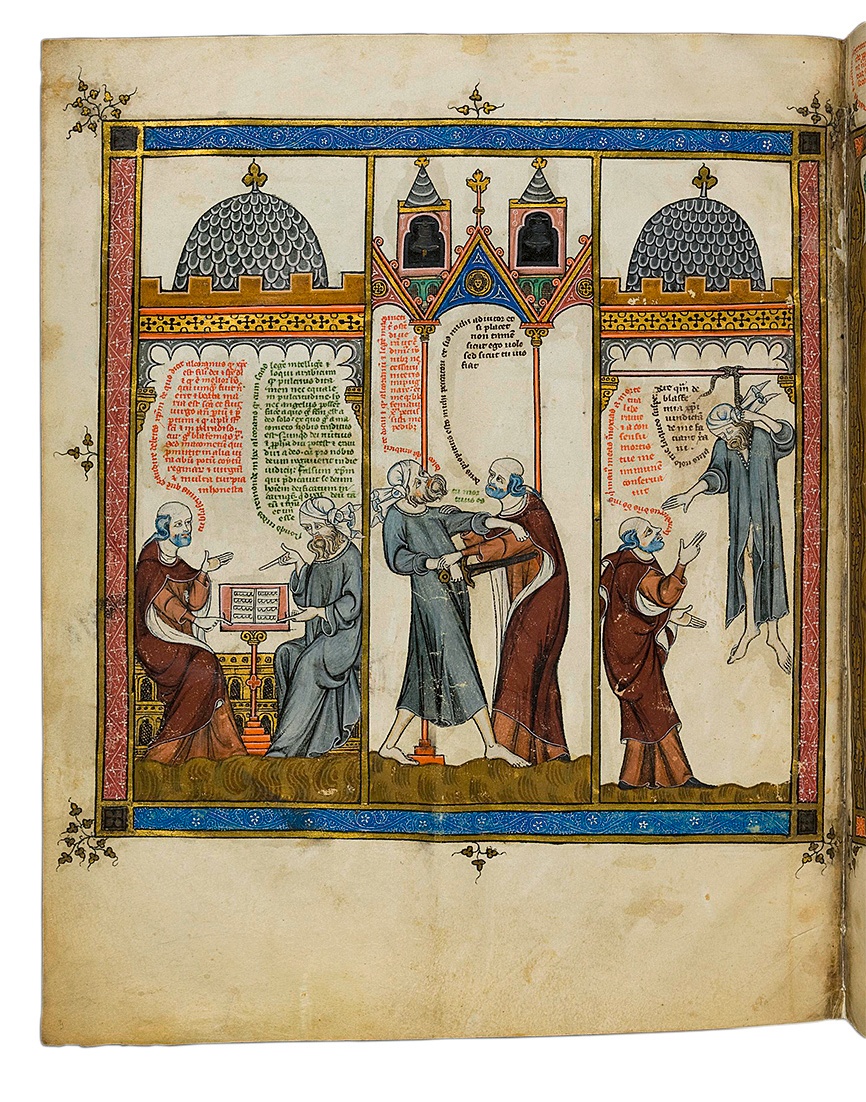
“Breviculum ex artibus Raimundi Lulli electrum,” ca. 1316
HUSSEIN FANCY: We both think and write a good deal about the ways in which the Middle Ages are deployed to think about Islam. It is interesting, for instance, to note how Islam is understood as medieval and yet, somehow, timeless. We can get to the question of what Islam is, but should we first try to define what the Middle Ages are? What do you mean by medieval? What kind of problems does it raise for you?
WENDY SHAW: An odd thing about the word medieval is that it’s a 19th-century English neologism based on Latin. Thus, it articulates a throwback desire for Latin as a universalizing linguistic power by a modern one and, in doing so, suggests a flyover era between two empires. When we consider the later years of the so-called Middle Ages, two developments strike me. One of them is a mercantile economic framework including a lot of interregional trade that doesn’t focus on commodification in the same way as later in capitalism. The other is the relative negotiation of power between state and religious forces. In the medieval period, religious structures are a central political actor, and modernity emerges through the construction of larger empires that are better able to challenge the power of the church.
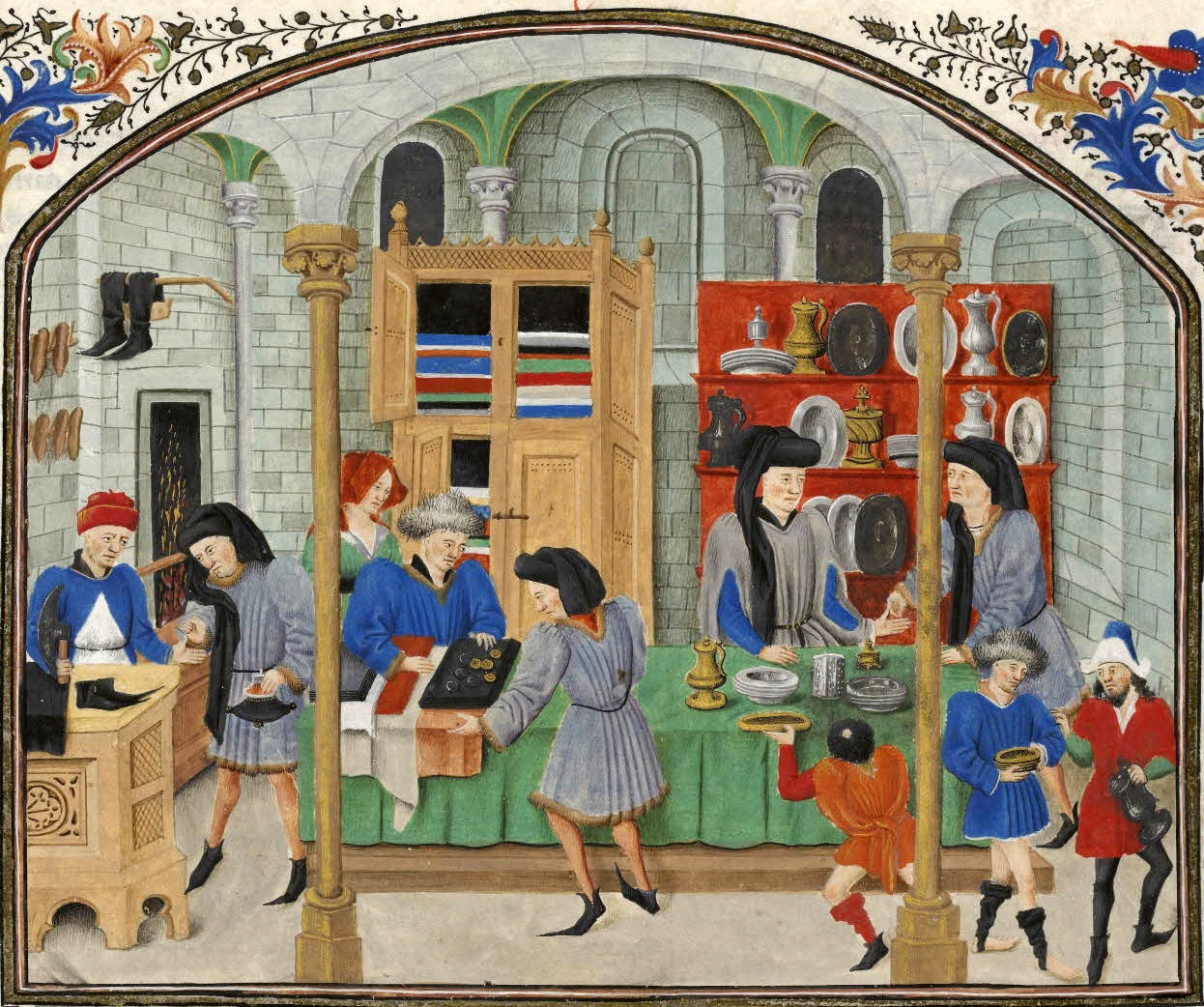
Medieval market, 15th century
FANCY: If I am to revise my own question, I say, What do the Middle Ages do? For me, one of the things we gain by asking this question – as opposed to, What are they? – is an attention to how the Middle Ages change and oscillate over time in the Western European intellectual tradition. At the end of the medieval period, Francesco Petrarca, Petrarch, first used the expression medium aevum. For him and the men and women of the Renaissance, the Middle Ages were an unfortunate interlude between the Roman Empire and their own time, a period better forgotten because there was nothing to learn from it. In other words, from its very inception, the Middle Ages were a “flyover,” as you said. For Enlightenment figures, this negative assessment of the Middle Ages, as a time before the triumph of reason and capital over religion, continued. Intriguingly, however, there were other versions of the Middle Ages that are worth mentioning. For the 19th-century Romantic thinkers, the Middle Ages were a period of innocence and authenticity. And for the critics of capitalism, Karl Marx most prominently, they were a period not simply of religious tyranny but also of unalienated labor, marked by handicraft and the “mere provisioning of one’s needs” (Bedarfsdeckungprinzip). This strain of the Middle Ages, as anti-modernity, also found its way into critical theory through figures such as Michel Foucault and Georges Bataille. These uses of the Middle Ages are polemical. Given the vexed history of the idea of a Middle Ages, I might then ask, What would it mean to speak of an Islamic Middle Ages?
SHAW: In regard to the Islamic world, the medieval is not used to describe a historical period but strategically employed when talking about politics or gender issues, as you already hinted at. It serves as a catchall for a past that is relegated to something bad and old-fashioned, that doesn’t have the possibility for modernity. Thinking about early 20th-century Turkey, for example, the disavowal of the premodern was part of “modernization” reflecting the hegemony of the West even in regions not under direct colonial domination. This included the wholesale rejection of public expressions of religion, down to the very transformation of the Turkish alphabet from Arabic to Latin letters.
FANCY: Maybe with these cautions in mind, we’re ready to start talking about what was actually happening between the people we conventionally call Muslims and the people we conventionally call Christians, roughly between the years 500 and 1500. I recognize that that’s a lot of qualification. Often, this matter is taken up as a story of perceptions. What did Christians think of Muslims, and what did Muslims think of Christians? More particularly, the question of Christian-Islamic relations turns around the idea of distortion. Why and when do Christians distort the image of Islam and vice versa?
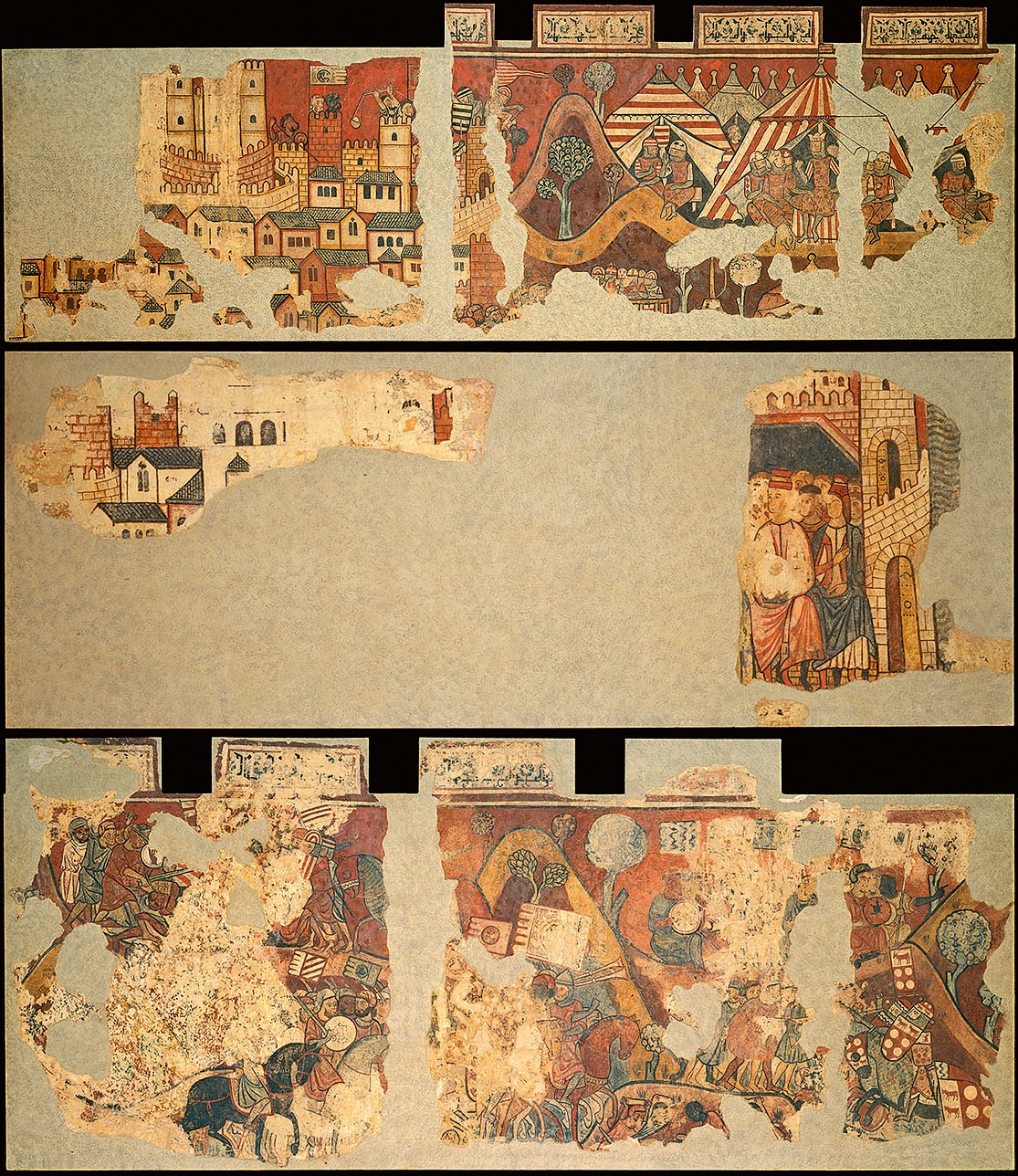
Mural paintings of the Conquest of Majorca, 1285–90
SHAW: My recent work has been about just this period – the interest in Islam that emerges in Europe because of the desire to convert all people to Christianity before the Second Coming, following 13th-century apocalyptic interpretations of the Bible. The first of these writings about Islam, even the first translation of the Qur’an, were based on the premise of a “false” prophet delivering a “false” book. The purpose was not to learn about Islam so much as to inform Muslims that they had been deceived.
FANCY: I agree that when Christians looked at Muslims in the Middle Ages, they were often looking through rather thick lenses. The reverse was often also true. What troubles me in my own study of perceptions is the background idea that there could have been an accurate and true portrait of Islam or Christianity at all. I often see written but struggle to understand the expression, “medieval Christians never understood Islam on its own terms.” While sympathetic, I also recognize that this line of argument suggests that Islam exists as something objective, fixed, and reducible to something called religion, separate from politics, culture, and so on. For my part, it’s important that when I write about medieval Islam and medieval Christianity to take seriously that these are dynamic traditions. There are Islams and Christianities, plural. Aside from the vast literature on perceptions, there is another, surprisingly disconnected body of scholarship related to trade, exchange, and material culture: the trade of goods between Jews, Christians, and Muslims; the movement of objects, money, and even enslaved or captive people. What interests me about this second body of scholarship is how often and how deeply invested in the narrative of the “rise of capitalism” it is, how it often implicitly presumes this inevitable end point. When we see medieval trade as a prelude to capitalism, we implicitly suggest that when Jews, Christians, and Muslims traded with each other, they did so in tension with, without regard for, or in direct contradiction to their religious values. In other words, we see religion – whether taken as cultural or theological – as an impediment. I see a similar pattern of thought across much of the research on the Middle Ages. What do you think the medieval does in relation to Islamic art history?
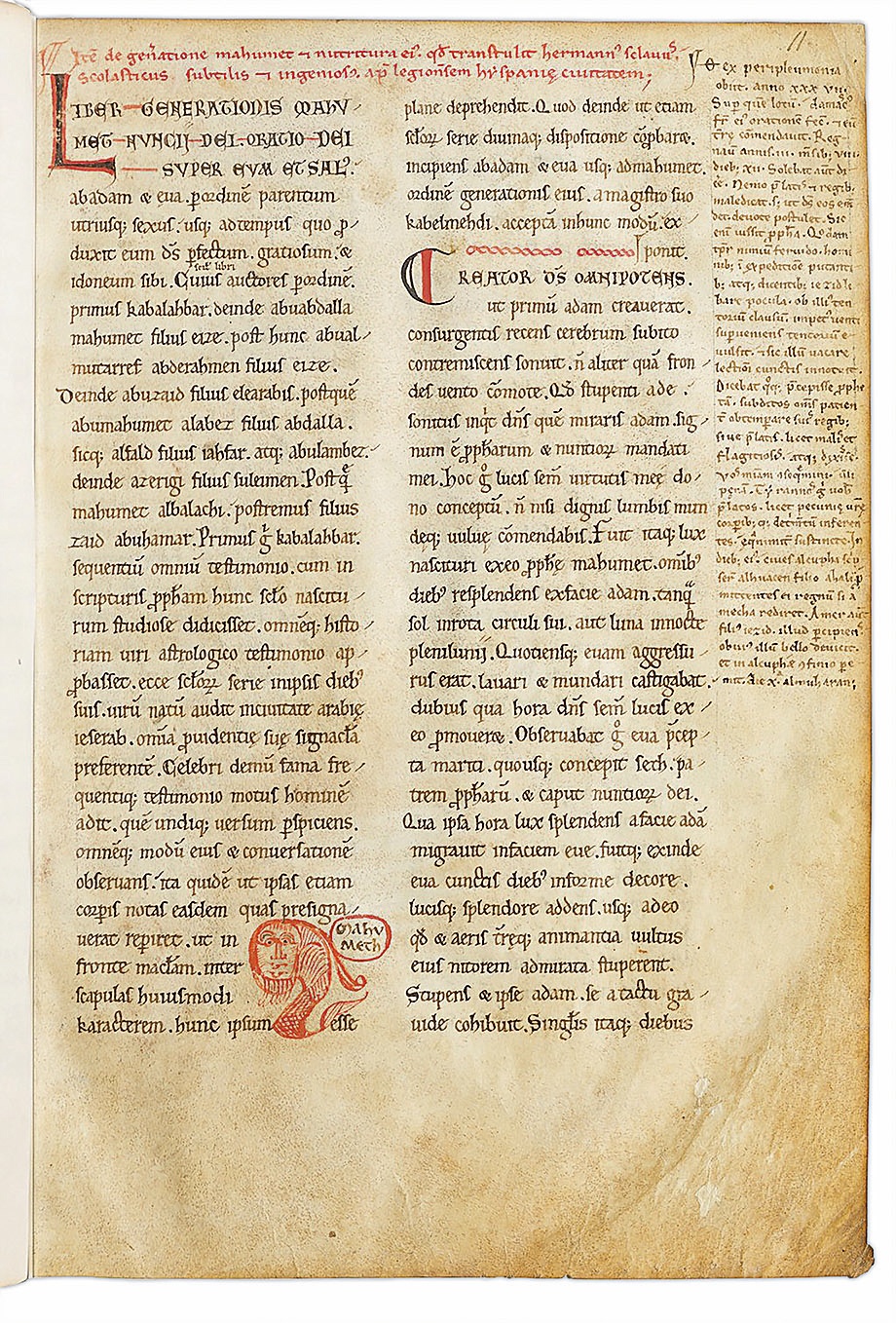
The first known image of Muḥammad in a Latin manuscript, ca. 1142–43
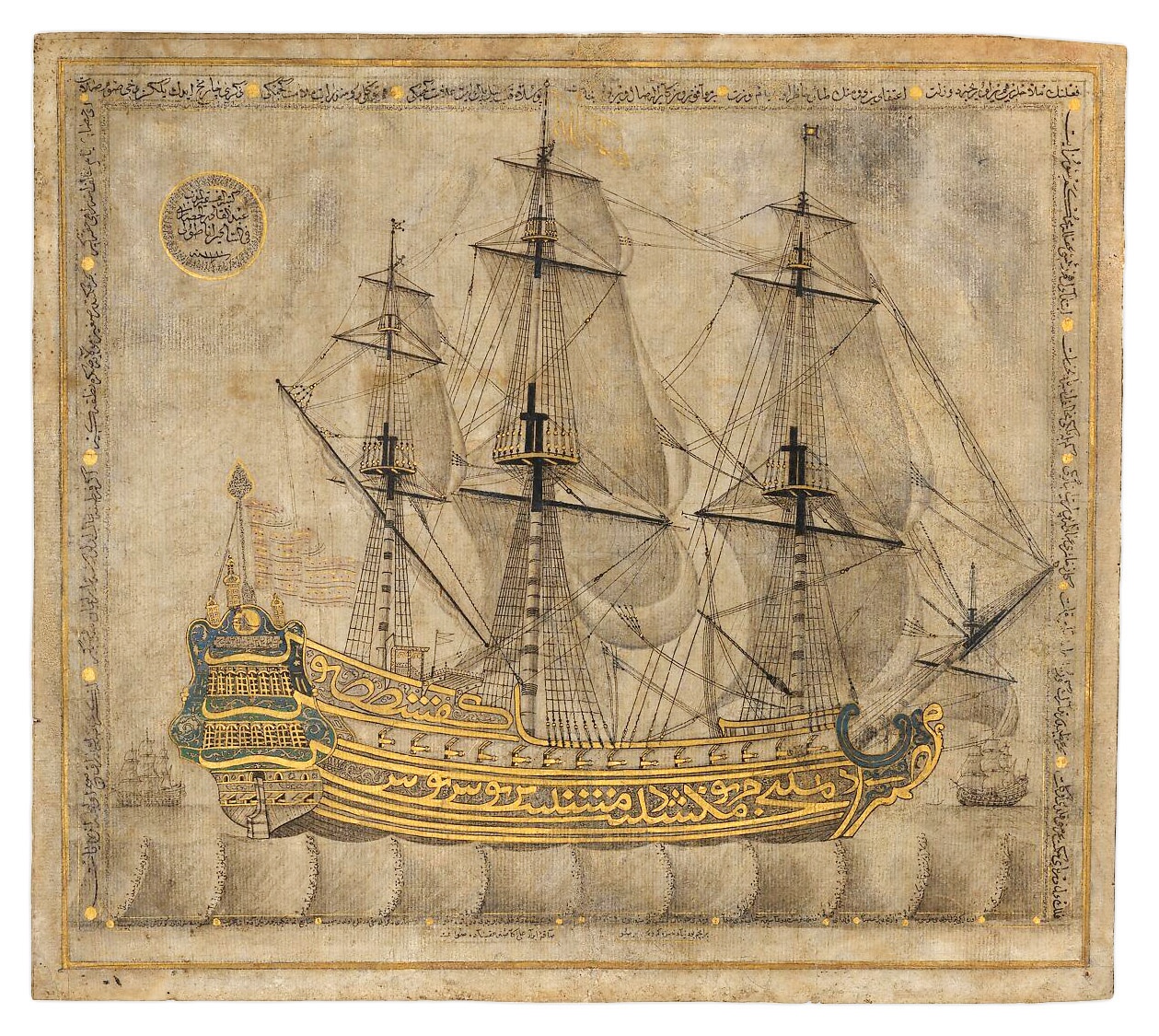
Abd al-Qadir Hisari, “Calligraphic Galleon,” 1766–67
FANCY: This is a fascinating answer and says two things that strike me as true. One, that it is impossible to answer the “What is medieval?” question without also answering how and why it is we have the very things we take for medieval as indexical of the Middle Ages. You were pointing to colonialism and capitalist networks – namely, the very institutions that make the medieval legible and are inextricable from the intellectual inheritance that defined the word medieval in the first place. The other thing that struck me as true is an almost cautionary statement that the medieval is always partial. It is always in service of something or being produced by something. At the same time, you were arguing it is doing the opposite to some degree: It makes possible the subversion of the very presupposition of a modern capitalist way of organizing the world. I would be interested in learning more about your work on museums and the ways in which other places, times, and people are captured in the context of a cultural institution, how they are placed within a particular narrative of modernity.
SHAW: I previously worked on what it has meant to import Western art and its institutions into the late Ottoman Empire and modern Turkey, from about 1800 to the mid-20th century. The idea not only of art but of tying artistic practice to notions of progress and identity is part of a universalizing modernity that equates Islamic art with a mythically ever-unchanging medieval. Later, I became interested in asking what it would mean if we weren’t thinking about Islamic art through the hegemonic paradigm of modernity. How have people engaged with their not just visual but also sensual world – to stay clear of the “aesthetic” – outside of the West? I encountered the disciplinary limitations of how art historians engage with the historical world based on this focus on the political and, of course, financial value of collecting. I came to understand “Islamic art” less as a category than as a discursive formation, as described by Foucault – a mutually recognizable referential system. In Islamic poetry and theological discussions, especially, I found the expression of a worldview that is not about politics, geography, or even language, but about how we perceive the world through the media we encounter and create.
FANCY: When I turned to the medieval period, first as an aspiring novelist and then as a graduate student, I was also hoping to find a world outside of modernity and my discontents with it – namely, that modernity excluded me as a Muslim, as a racialized body, and moralized about other worlds that I identified with. What I discovered reading medieval texts as a scholar for the first time was how utterly rebarbative they are, how they resisted my desire for them to say the things that I wanted them to say. They did not give me an authentic portrait of Islam or premodernity or religion before modernity. I found them striking in ways I didn’t imagine, opening up worlds I didn’t think were there – some of which were troubling. For instance, just as there was no uniform picture of Islam, there was no uniform picture of Christianity or Judaism, no history of the past that could serve as a salve for the aches of the present. Instead of finding some specific thing, I found pleasure in the act of working with archival materials. An attempt to be faithful to the language, symbols, and tensions in documents imposed pleasurable constraints on what I could say and do and imagine as a scholar, almost as if I were writing formal poetry. How can I make this 800-year-old text speak again? It requires fidelity and, at the same time, a radical and exciting openness to method. The almost absurd task of taking medieval sources seriously exaggerates the universal challenge of reading and making meaning from texts and objects in general. Most plainly, it lays bare the question, Do things universally signify, or do they only contingently signify? Is their meaning translatable or merely embedded in the circumstances of their production?
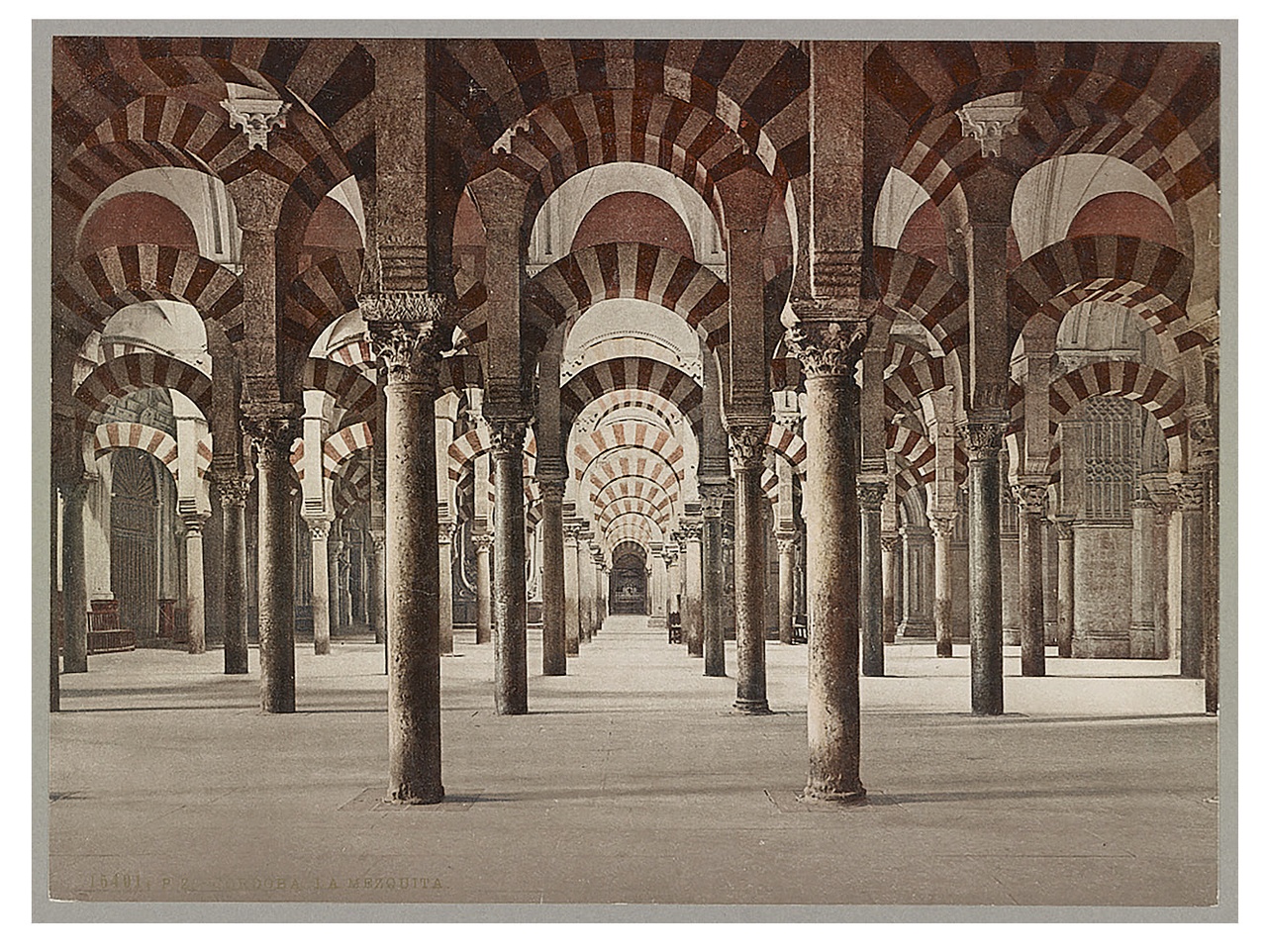
Prayer hall in the Mosque–Cathedral of Córdoba, after 987
SHAW: What I’m hearing, which was also my experience, is that engaging with the medieval sets up a mirror in which central ideological concepts of modernity – such as progress, individualism, universalism, and democracy, as well as how they presuppose certain hierarchies, such as hierarchies of belonging – really become apparent. I really like your idea of making documents speak in a diversity of methods. One thing I’ve thought about in relation to the museum is how to make exhibits speak in a realistic setting that’s not about the progression of styles or dynasties but about how people in a culture might encounter objects in time and space, beside each other, as available or hidden, handled or sequestered, within the multisensory environments of life. We are accustomed to seeing objects of a certain type organized by geography and time, a form of museum presentation developed in the 19th century reflecting Hegelian ideas about progress. In 2011, the Metropolitan Museum of Art in New York changed the name of its galleries dedicated to Islamic art to “Art of the Arab Lands, Turkey, Iran, Central Asia, and Later South Asia.” While calling this wing “Islamic Art” excluded local Christians and Jews, naming it partly in accordance with today’s nation-states excludes all the ethnic minorities in these regions. Peter Schjeldahl, in his review “Old and New: The Reopening of the Islamic Wing of the Met” for The New Yorker, writes, “It [the exhibition] made me acutely conscious of myself as European-American – a latter-day scion of the Renaissance wedding of Greek and Roman with Judeo-Christian traditions. It did this by reversing my sense of Islam as a topic of study: rather abruptly, Islam seemed to be scrutinizing me.” I found the comment telling in that despite the overt discussion of “Islam” from a theological framework, a critic like Schjeldahl lacked intellectual tools with which to engage with the exhibits. In consequence, he perceived the unknown as a threatening counter-hegemony, capable of examining him. This reflects a latent fear of Islam as well as a need to curatorially approach the works in these galleries through their cultural specificity rather than applying terminologies like painting and ceramics or concepts like authorship and dynasty as their primary frames, adopted from a European epistemic systematization of art. Such articulation provides information but retains the alienation Schjeldahl expressed.
FANCY: If in Schjeldahl’s reading, as I hear it in your quotation, Islam stands outside the Judeo-Christian tradition, outside the Greek and Roman inheritance, then it is also worth exploring the opposite argument, which appears often enough in historical studies: Islam kept the Greek and Roman tradition alive during the Middle Ages and transferred reason and logic to the “West” without itself contributing anything meaningful. Whether as outsider or transmitter, Islam is still alien, as you say. There’s a lot that can be said of the fallacy of both these lines of argument. I’ll simply add that the expression “Judeo-Christian traditions” emerges only in the 20th century. In truth, as Richard Bulliet has argued, one could make a better case of Islamo-Christian civilization if one wanted.
SHAW: I would like to highlight what you spoke about earlier: the incorrect assumption that religious people are not secular or that faith is always prioritized over reason. One way to challenge that assumption is by looking at the theological disputations between Christians and Muslims and Jews. Underlying many debates over truth and falsehood between the Abrahamitic religions is the idea that you can have faith though understanding, or that you can enlighten somebody rationally. This, of course, connects to shifting power relationships between church and state over who controls what reason is.
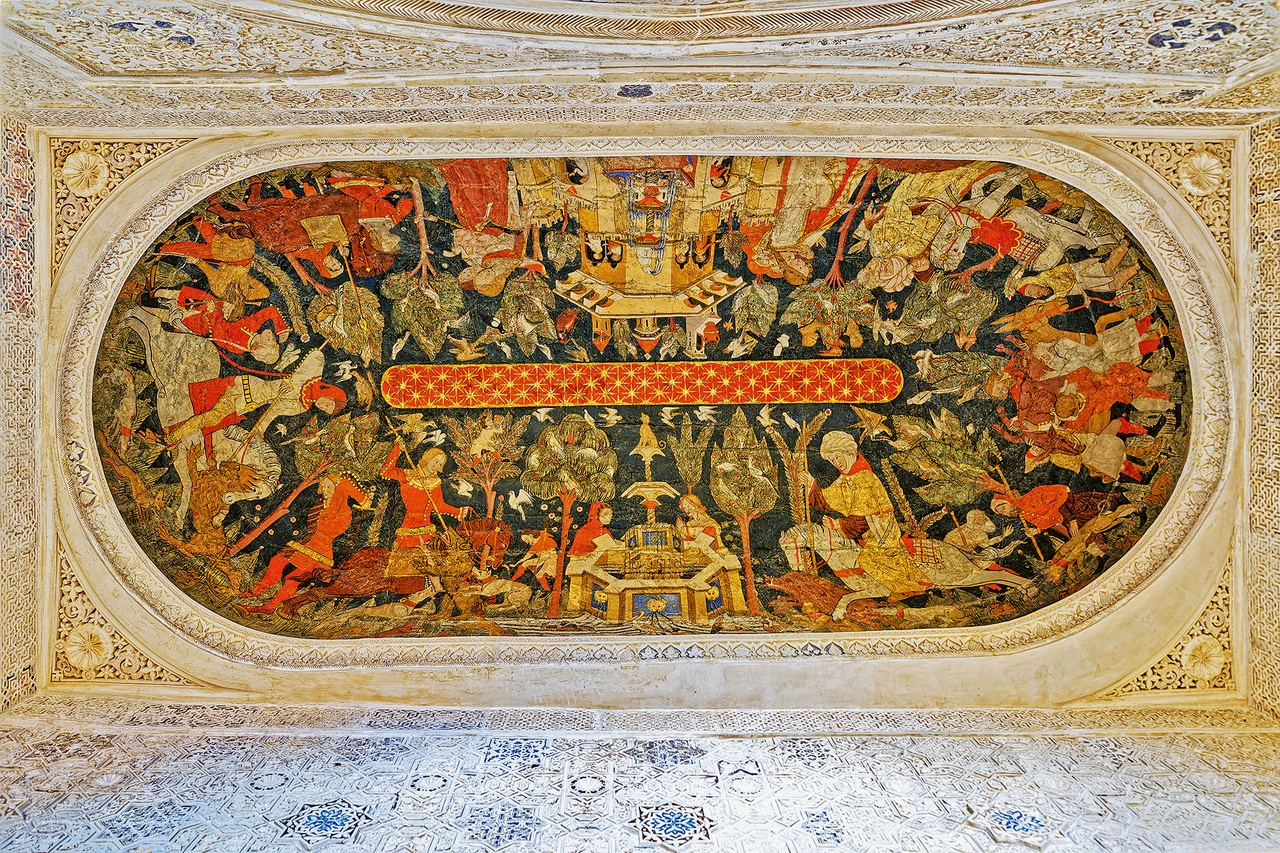
Ceiling bay in the Sala de los Reyes, Alhambra Palace, Granada, ca. 1370–80
FANCY: I am very interested in the fact that what Christians meant by the relationship between the sacred and the secular – their words – changed dramatically over the 12th and 13th centuries, and this change, in turn, had a dramatic impact on the way they understood the Islamic world. As I’ve said earlier, I see the distinction between sacred and secular as polemical both in the past and present. For instance, in the Middle Ages, there were extremely positive descriptions of Muslims as powerful, as wealthy and successful, as learned. Thomas Aquinas doesn’t speak about his Christian contemporaries as his intellectual rivals but rather about Ibn Rushd, a near contemporary in North Africa. When we look closely at the way Christians make sense of the Islamic world in the medieval period, we hear praise of Islam’s evident material and secular success but also an implicit and explicit denial of its theological legitimacy. Even in the Middle Ages, I’m saying, secularism was used in a polemicizing manner.
SHAW: This also calls into question the separation of church and state in modern society as secularism or laicity. Such an understanding of secularism implies that there are economic and material practices guided by reason – and there is religion that is an identity. What is overlooked here is that faith is a set of practices that constitute a different way of being in the world than those guided by capitalist modernity.
FANCY: It also challenges what we mean by the medieval. For example, what we call Catholic Christianity finds its full expression only in the 13th century. Significantly, this is also the moment when Christianity shatters into multiple shapes and forms in response to a unifying impulse by elite churchmen. The Middle Ages were, in fact, a period of remarkable and radical diversity of thought and experience. Despite this radical diversity, a rather staid version of the Middle Ages has been constitutive of and constituted by theories of modernity. In other words, thinking about modernity is always implicitly thinking about the medieval. One fiction begets another – in which order, I don’t know. This intimate and mutually constitutive relationship between medieval and modern makes me question whether the theoretical Middle Ages, as imagined by Foucault, Bataille, or Tala Asad, and others, can genuinely be a resource for critiquing modernity.
Hussein Fancy is an associate professor of history at Yale University. His research and writing focus on the social, cultural, and intellectual history of interaction between Jews, Christians, and Muslims in the medieval Mediterranean. In particular, he is interested in projects that combine the use of Latin, Arabic, and Romance archival sources. His first book, The Mercenary Mediterranean, (University of Chicago Press, 2016), received multiple awards, including the Herbert Baxter Adams Prize, for best first book in European history, from the American Historical Association. He is currently working on two projects. The first, entitled The Impostor Sea: The Making of the Medieval Mediterranean, follows the activities of criminal merchants – pirates and smugglers – to rethink the relationship between religion and trade. The second, entitled The Eastern Question, examines Western views of Islam from the 7th century to the present, arguing that both positive and negative images of Islam across history share the same polemical genealogy. Fancy was a junior fellow of the Michigan Society of Fellows, a Carnegie Scholar, an ACLS Fellow, and a Rome Prize Fellow.
Wendy Shaw worked as a professor in “Islamic” and “world” art history at six universities in four countries for two decades, during which she authored Possessors and Possessed: Museums, Archaeology, and the Visualization of History in the Late Ottoman Empire (2003); Ottoman Painting: Reflections of Western Art from the Ottoman Empire to the Turkish Republic (2011); What is “Islamic” Art: Between Religion and Perception (2019); and Loving Writing: Techniques for the University and Beyond (2021), in addition to numerous articles about postcolonial and decolonial approaches to art, archaeology, and museology in the context of modern Turkey, as well as Platonic and Islamic thought. Like a bull in a china shop, she currently works independently, developing alternative expressive modes for academic knowledge through literature, poetry, and visual arts. She lives in Berlin.
Image credit: 1. Badische Landesbibliothek; 2. Bibliothèque Municipale; 3. Museu Nacional d’Art de Catalunya; 4. Bibliothèque de l’Arsenal; 5. Metropolitan Museum of Art; 6. Photoglob Company, all public domain