
CAPITALIST TURNING POINTS: REFEUDALIZATION Sighard Neckel
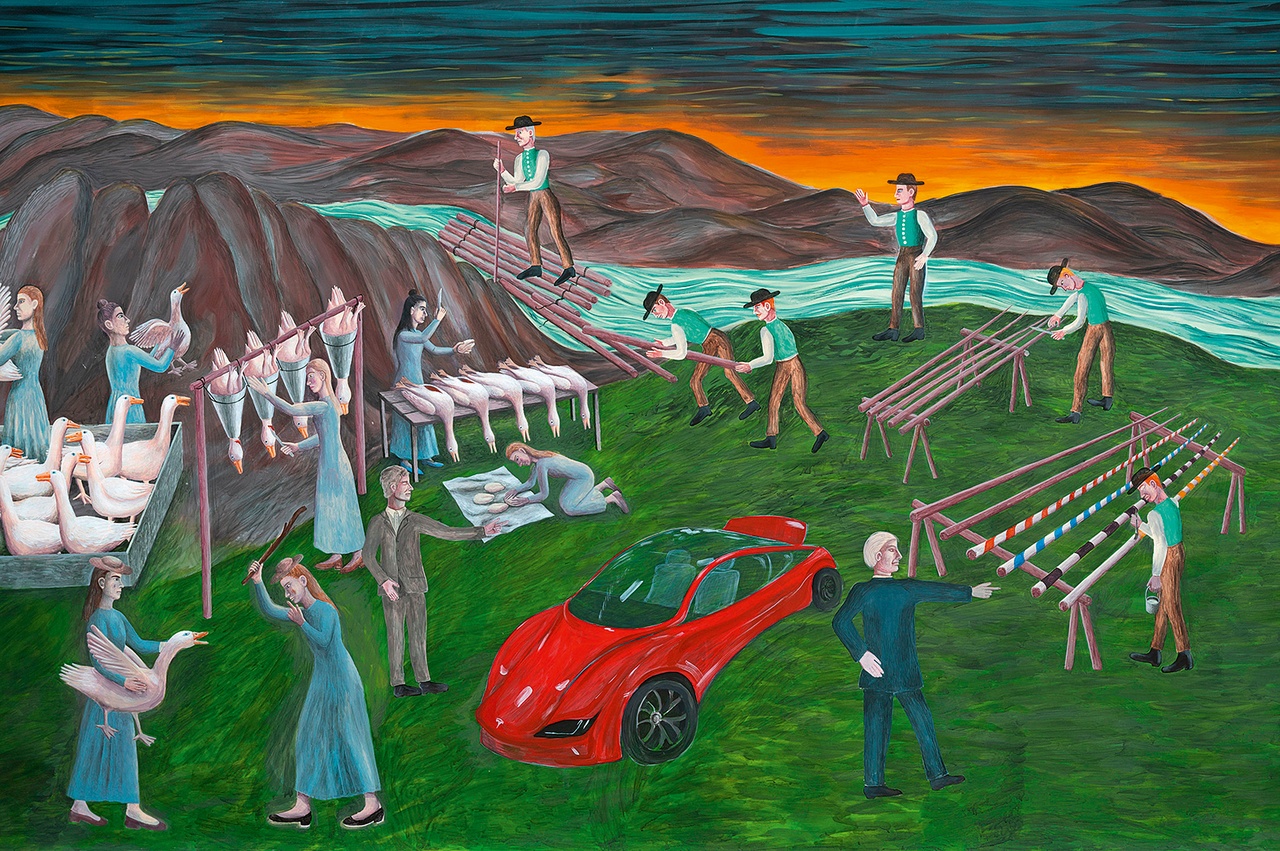
Agnes Scherer, “Savoir Vivre,” 2023
Modern capitalism has rarely existed in the temporal dimension of a pure present. In particular, periods marked by major increases in wealth among the upper classes have repeatedly seen the emergence of social forms that recall the economic practices, political modes of rule, and cultural symbolisms of past eras. At the dawn of the 20th century, during the United States’ “Gilded Age,” with its economic prosperity and the rise of the fantastically rich robber barons, the sociologist Thorstein Veblen described the aristocratization of the US upper classes as the “conspicuous consumption” of a “leisure class” that sought to emulate the splendor of feudal times. [1] Such historical hybridizations led Max Weber to the insight that the modern class division would not override the premodern principle of stratification by estates. Especially the propertied classes frequently tended to harness their excessive wealth, unconstrained claims on power, and spectacular lifestyle displays to obtain prerogatives of estates amid the modern social order. [2]
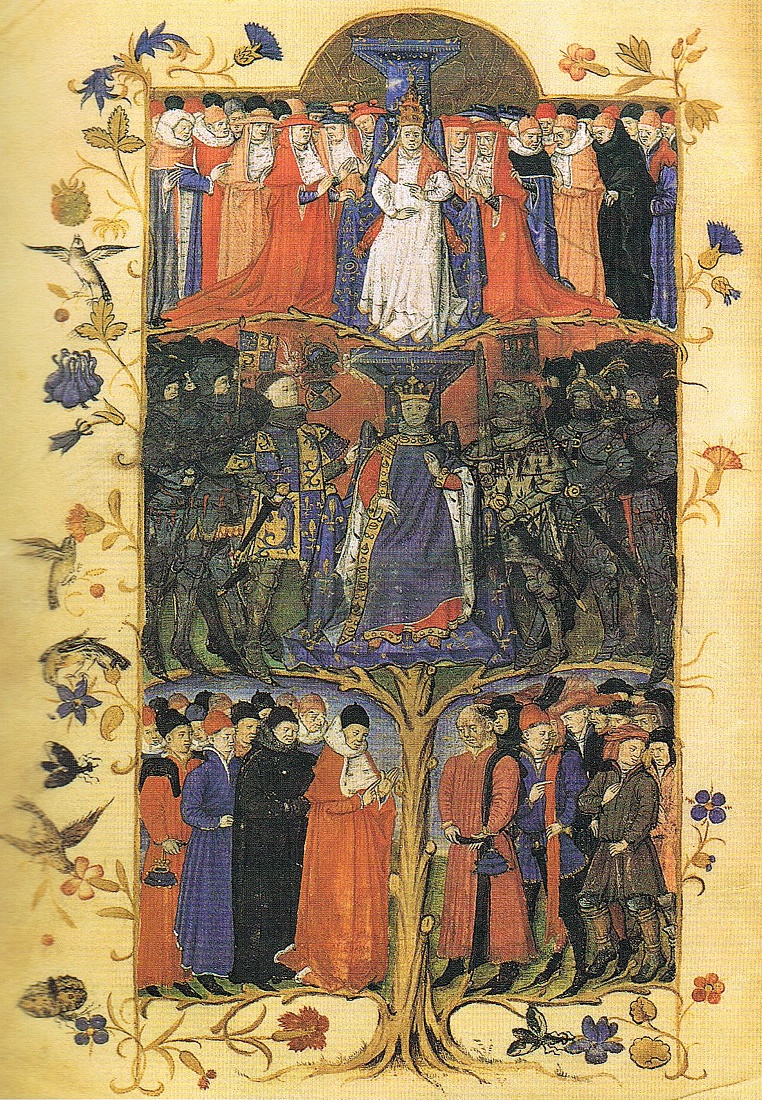
Medieval social tableau, 15th century
Social change establishing continuities between antithetical historical phenomena and bringing about an imbrication of new and old social forms: Something similar may be observed in our own age, in which the capitalist megalomania of digital corporate giants and tech moguls with delusions of grandeur has become a defining concern for the critical public. Buoyed by the rise of financial market capitalism and the digital revolution, a new class of the superrich has taken the stage in the two and a half decades since the turn of the millennium. At first, this class was primarily interested in increasing its enormous returns and accumulating historically unprecedented wealth; the world’s billionaires are now worth 18.3 trillion US dollars, and globally, the wealthiest 1 percent hold almost 44 percent of all assets in the world. Elon Musk, currently the richest of the rich, makes in four seconds what the global average person earns in a year. [3] Such vast discrepancies in the sheer volume of money available to individuals defeat all historical comparisons that economic historians surveying past eras of social inequality might muster.
In the course of this development, we have witnessed the return of categories and ways of thinking that seem anachronistic in that they contradict the spirit of a democratic capitalism whose sustainability Western societies were still by and large convinced of after the seismic shift of 1990. Democratic capitalism has come under pressure from many different directions. Economically, the capitalist market economy has transformed into a capitalism without bourgeoisie. The gigantic wealth at the apex of the income hierarchies is primarily not the fruit of entrepreneurial activity but of the un-bourgeois principle of heredity. Of Germany’s billionaires and multimillionaires, 75 percent have inherited a significant part of their wealth; this has been made possible by a long era of peace and uninterrupted growth that allowed assets to accumulate in family enterprises. [4] The Pilgrim Fathers, the intellectual forebears of capitalism in the United States, still believed that an honorable man met his divine judge with empty pockets. Seminal thinkers of liberalism such as Jeremy Bentham and John Stuart Mill saw the principle of heredity as a relic of the aristocratic era. Yet it is this un-bourgeois principle that is now the primary driver of an enormous wealth concentration. It sustains the dynastic structure in the upper class’s bel étage, which increasingly relies on the transfer of unearned wealth within families. To the extent that the growth of that wealth is based on returns from financial markets, those returns are earned not from investments into productive forces but from ownership titles over assets from which profits are derived through arbitrage, windfalls, or speculative gains. This modern “rentier capitalism” has more in common with the incomes of feudal landowners than with the surplus product appropriated by the bourgeois entrepreneur, who still needs to contribute to social value creation to earn his profits. [5]
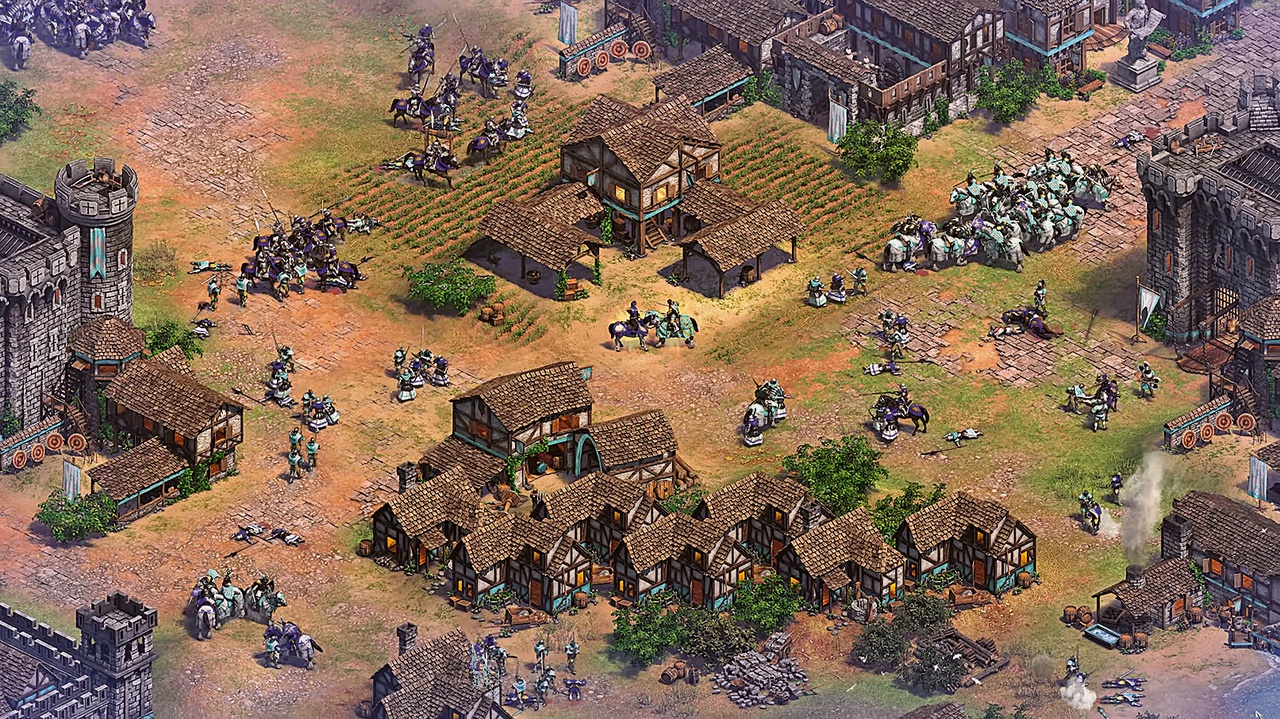
Ensemble Studios, “Age of Empires II: Definitive Edition,” 2021
Analogies with pre-bourgeois economic practices are most evident today in the modes of operation by which tech capitalism generates its huge returns. The platform economy rests on principles that are far older than capitalism. Tech capitalists own the digital infrastructures and the algorithms that run on them. Platform users provide their labor power free of charge, for it is their activities that continually enrich and optimize the algorithms, an extraordinarily profitable business in the age of artificial intelligence. The tech capitalists, meanwhile, provide their digital land as a fiefdom, for which they are compensated by users providing free labor. In this way, they realize profits as the landowners of precapitalist times did: from vassals rendering personal services.
Yanis Varoufakis has dubbed this highly modern retrotopia “technofeudalism” in his widely noted book of the same name. [6] His contribution is the latest salvo in a debate that, for well over a decade, has explored aspects of “neofeudalism” amid the modern social order. [7] In fact, the diagnosis that modernity is regressing into feudalism is factually supported by a variety of evidence. Besides the return of economic categories such as fiefdoms and rents, this includes the closure of an estate-based upper class, which now continually reproduces itself from within its own circles. Meanwhile, the precarization of wage labor is taking forms that jettison the bourgeois legal principle of the labor contract and reactivate old patterns of servitude.
Strong support for the neofeudalism thesis is supplied by the process of transforming wealth into power: One defining feature of feudalism was that it did not recognize any separation of the spheres of state and society, politics and economic activity, private and public, so that status and wealth translated seamlessly into power. As long as members of the contemporary superrich class derived political power mostly from their excessive wealth and exerted influence on political decisions primarily by way of the financial markets, their ability to sway states appeared above all as a veto power over unwanted social changes. This shifted when the superrich gained power over key digital technologies – now the global economy’s cognitive and affective brain, which is sending its disruptive messages also to the public and political spheres. In the United States of America, the digital infrastructure of government, the military, intelligence agencies, communication networks, energy systems, human resource management, satellite systems, financial instruments, platforms, and cloud computing is increasingly the private property of an authoritarian high-tech complex of imperious techno-kings and apocalyptically minded libertarian extremists. They are corralling the state into ever more profound structural dependence on their companies, effectively gaining sovereignty for themselves. Just a decade ago, these new oligarchs’ daydreams revolved around the establishment of non-state enclaves for the rich in private territories, on their own islands, or in orbit. Nowadays, it makes sense for them to take charge of the state itself, to think of political sovereignty as an investment, to exercise sovereign functions as corporate affairs, to fuse the state with powerful private enterprises. This privatization of political power collapses the distinction between business and law. As in the pre-bourgeois era, individuals’ economic power translates into control over the body politic and the public. The public as a social sphere that can withstand the pressures of economic and political forces is transformed into private property ruled by the powerful through their control of the algorithms.
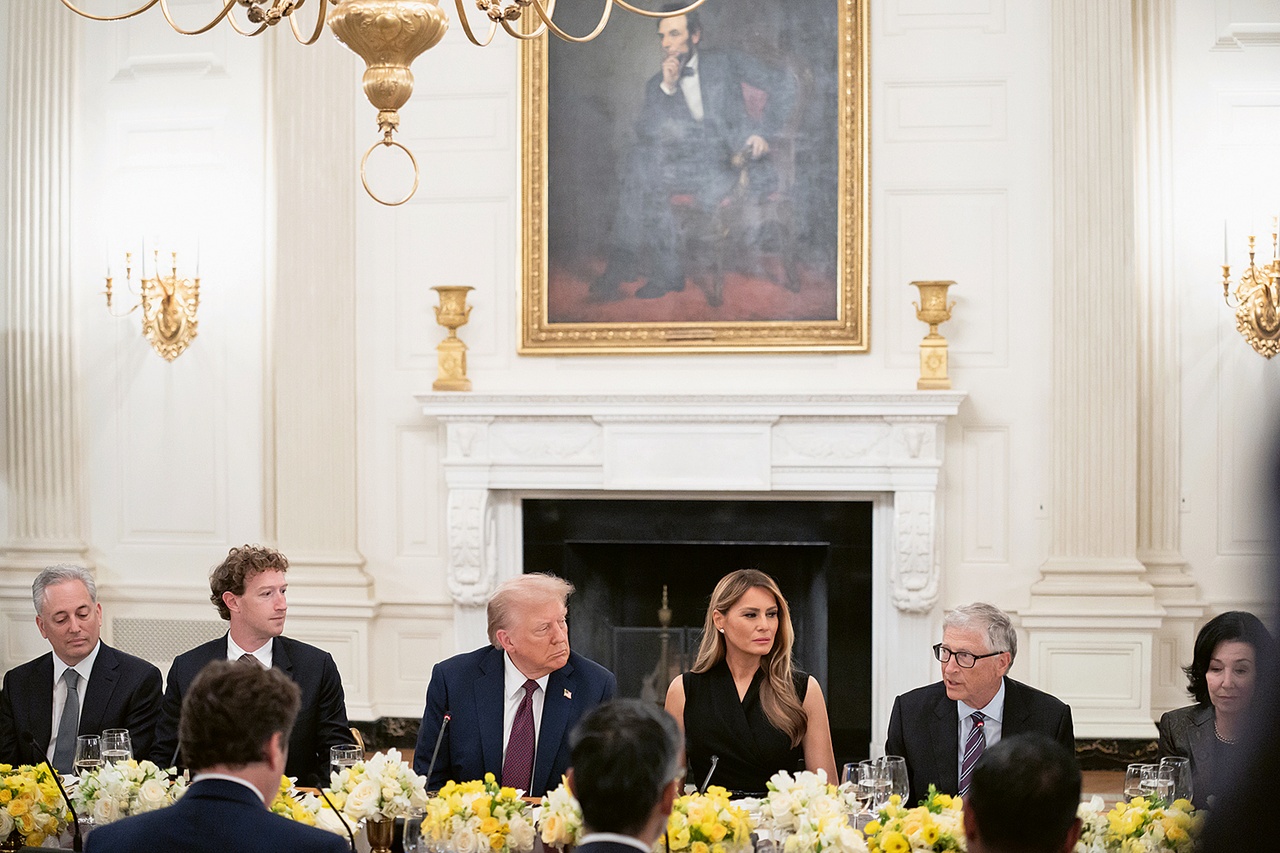
“Tech Dinner” at the White House, Washington, D.C., 2025
All these observations would seem to strongly support the thesis that we are witnessing a neofeudalism that, as Varoufakis assumes, will dig capitalism’s grave. Yet its proponents suffer from a misunderstanding of the forces driving this development, which, needless to say, are capitalist in nature. Neofeudalism does not abolish fundamental principles of capitalism such as the imperatives of expanded accumulation, profit maximization, and the pursuit of monopolistic control over private ownership rights; on the contrary, it rests on them. Nor are today’s tech oligarchs an aristocracy by birth that exploits the disenfranchised populace and is subject, if at all, only to an imperial overlord. Far more than in stark submission, the techno kings are interested in turning late-modern subjects into “reflexive co-players”on the stages of their digital empires. [8] More plausible than the notion that we are regressing into feudal times is the idea that capitalism without bourgeoisie must be seen as the outcome of capitalism’s own modernization. Borrowing Jürgen Habermas’s concept of the “refeudalization” of modern capitalism, the pretensions of the new oligarchies can be understood to be the paradoxical product of a dynamic in contemporary society in which the modernization of capitalism engenders modes of economic organization and political rule that run counter to the maxims of a bourgeois social order. [9] Yet this very contradiction may be the social prerequisite for capitalism’s continuing global triumph. In a historical perspective, it would not be the first time that such contradiction propels a transformation of capitalism’s social order, with far-reaching consequences. In light of the fact that today’s refeudalization of modern capitalism is in league with authoritarian movements in the Western democracies and beyond, we should expect not so much a return to feudalism as the menacing possibility of a hypermodern techno-fascism.
Translation: Gerrit Jackson
Sighard Neckel is a sociologist and professor emeritus of society and social change at the University of Hamburg. From 2019 to 2023, he was the spokesperson of the DFG research group Futures of Sustainability, of which he has since been a senior permanent fellow. He previously held professorships in sociology at the universities of Gießen, Vienna, and Frankfurt am Main, where he was also a member of the Institute for Social Research. His most recent book is Katastrophenzeit. Die Gesellschaft im Klimawandel und die Fallstricke der Transformation (C. H. Beck, 2026).
Image credit: 1. © Agnes Scherer, 2. Bibliothèque de l’Arsenal, public domain, 3. Age of Empires, public domain 4. The White House collection, photo Andrea Hanks, public domain
Notes
| [1] | Thorstein Veblen, The Theory of the Leisure Class: An Economic Study in the Evolution of Institutions (Macmillan, 1899). |
| [2] | Max Weber, Economy and Society: An Outline of Interpretive Sociology [1922], ed. Guenther Roth and Claus Wittich (University of California Press, 1978), 931–32. |
| [3] | See Oxfam International, “Resisting the Rule of the Rich,” January 19, 2026. |
| [4] | “Milliardäre: Nur jeder Vierte in Deutschland hat sich das Vermögen selbst erarbeitet,” Datapulse, June 2025. |
| [5] | See Brett Christophers, Rentier Capitalism: Who Owns the Economy, and Who Pays for It? (Verso, 2020). |
| [6] | Yanis Varoufakis, Technofeudalism: What Killed Capitalism (Melville House, 2024). |
| [7] | See Sighard Neckel, “Refeudalisierung – Systematik und Aktualität eines Begriffs der Habermas’schen Gesellschaftsanalyse,” Leviathan 41, no. 1 (2013): 39–56; Joel Kotkin, The Coming of Neo-Feudalism: A Warning to the Global Middle Class (Encounter Books, 2020); Evgeny Morozov, “Critique of Techno-Feudal Reason,” New Left Review 133/134 (2022): 89–126; Robert van Krieken, “Refeudalization and Law: From the Rule of Law to Ties of Allegiance,” Annual Review of Law and Social Science 19 (2023): 337–55; Cédric Durand, How Silicon Valley Unleashed Techno-Feudalism, trans. David Broder (Verso, 2024); Vando Borghi, The Ruins of Capitalism and Possibilism: Beyond Homo Faber (Routledge, 2025). |
| [8] | See Sighard Neckel, “Die Verwilderung der Selbstbehauptung,” in Dialektik der Freiheit: Frankfurter Adorno-Konferenz 2003, ed. Axel Honneth (Suhrkamp, 2005), 188–204. |
| [9] | See, most recently, Sighard Neckel, “The Refeudalization of Modern Capitalism,” Journal of Sociology 56, no. 3 (2020): 472–86. |