
ANONYMITY AND AFFIDAMENTO Jaleh Mansoor on Emilia-Amalia in the Age of Institutional Indifference
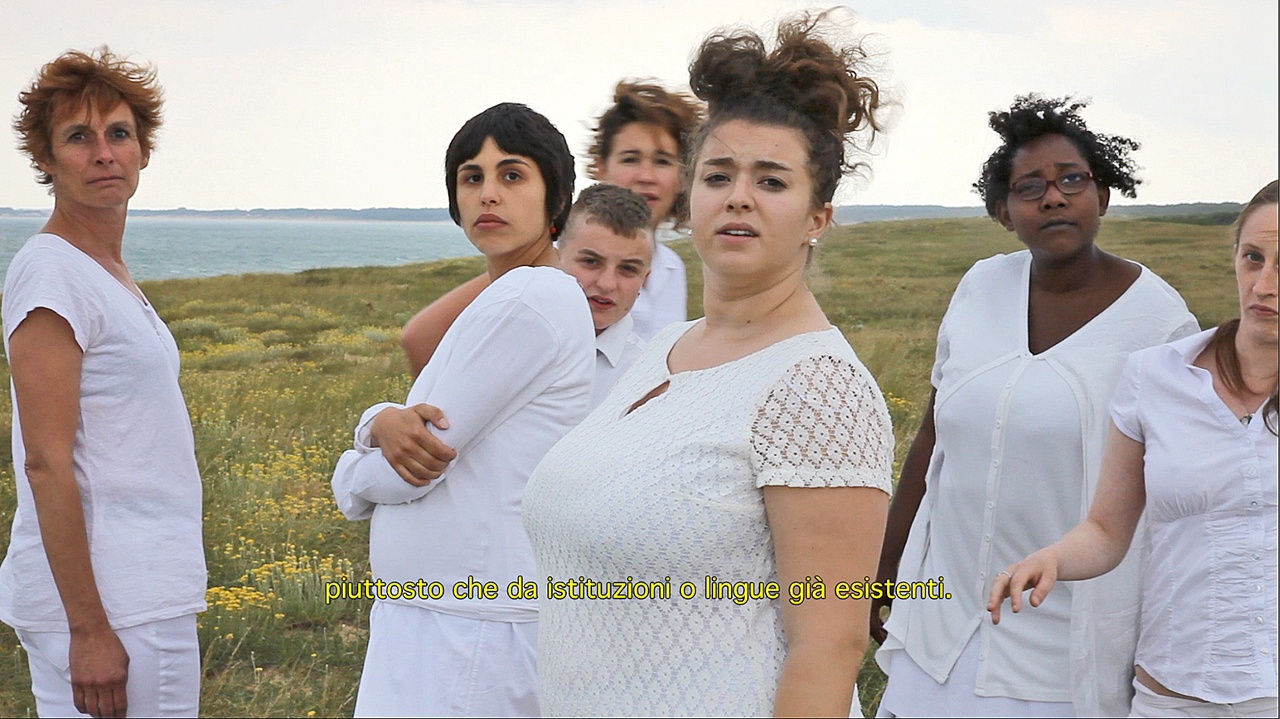
Alex Martinis Roe, “It was an unusual way of doing politics: there were friendships, loves, gossip, tears, flowers ...,” 2014
Everyday life within capitalist social relations, all of which appear concrete and “present,” is already beset by a second nature whereby real abstractions feel and seem ordinary. That’s what second nature does. [1] It makes highly artificial constructs – which, over time, reconstitute every element of existence on molecular and molar levels – appear to be fixed and timeless. Subjective experience, ever entering its existence in medias res, takes these synthetic social compositions to be both normal and normative. Individual identity as well as its various qualifications, each of which is taken to be inherent to reality, is just one among any number of abstractions. These appearances of individual identity are already an immense accumulation of masks presenting as faces. As Amy De’Ath has recently observed in her study of contemporaneity and culture, “no one on earth is identical to the form of appearance their person takes in capitalism.” [2] We take up various masks appropriate to contracted social roles: leader, husband, mother, administrator, and so on. If we are fortunate, these positions are lived as processes and practices that are open to deviation and sensitive to breaks, ruptures, and unforeseen swerves that pose satisfying and creative varieties of agency, experience, and meaning.
In turn, subject positions picked up as givens, absent the kinds of resistance necessary to agential creativity, are determined by socially necessary forms of production and reproduction. They become the parameters of what is sayable, doable, thinkable. These common and even ready-made subject positions are the more ordinary instances of performativity assimilating to external constraints. And yet the internalization of external constraints comes to be calcified to seem autochthonous to the self. As Michel Foucault reminds us in “What Is an Author?,” the coordinates of authorship are decided, regulated, and verified by temporal consistency as much as by property and legality. [3] And so historically, when authorship contradicted or, worse, negated another invariable identity within a social constellation – gendered or racialized persons, for instance, who were not supposed to have any agential or creative capacity – a nom de plume became a mask on top of a mask, cancelling the first mask to enable process and practice to move freely.
A counterstrategy to the everyday functional demand to assume an identity, a mask, might be to demand an open avowal of this normative condition within a social context. But meta-level forms of unmasking with an aim to uncover a final authentic support of the self are beside the point. There is no final authentic support; species-being transforms and adapts to the circumstances it creates. [4] Gendered or racialized subject positions are historically emergent as much as professional types, such as the privilege of authorship. [5]
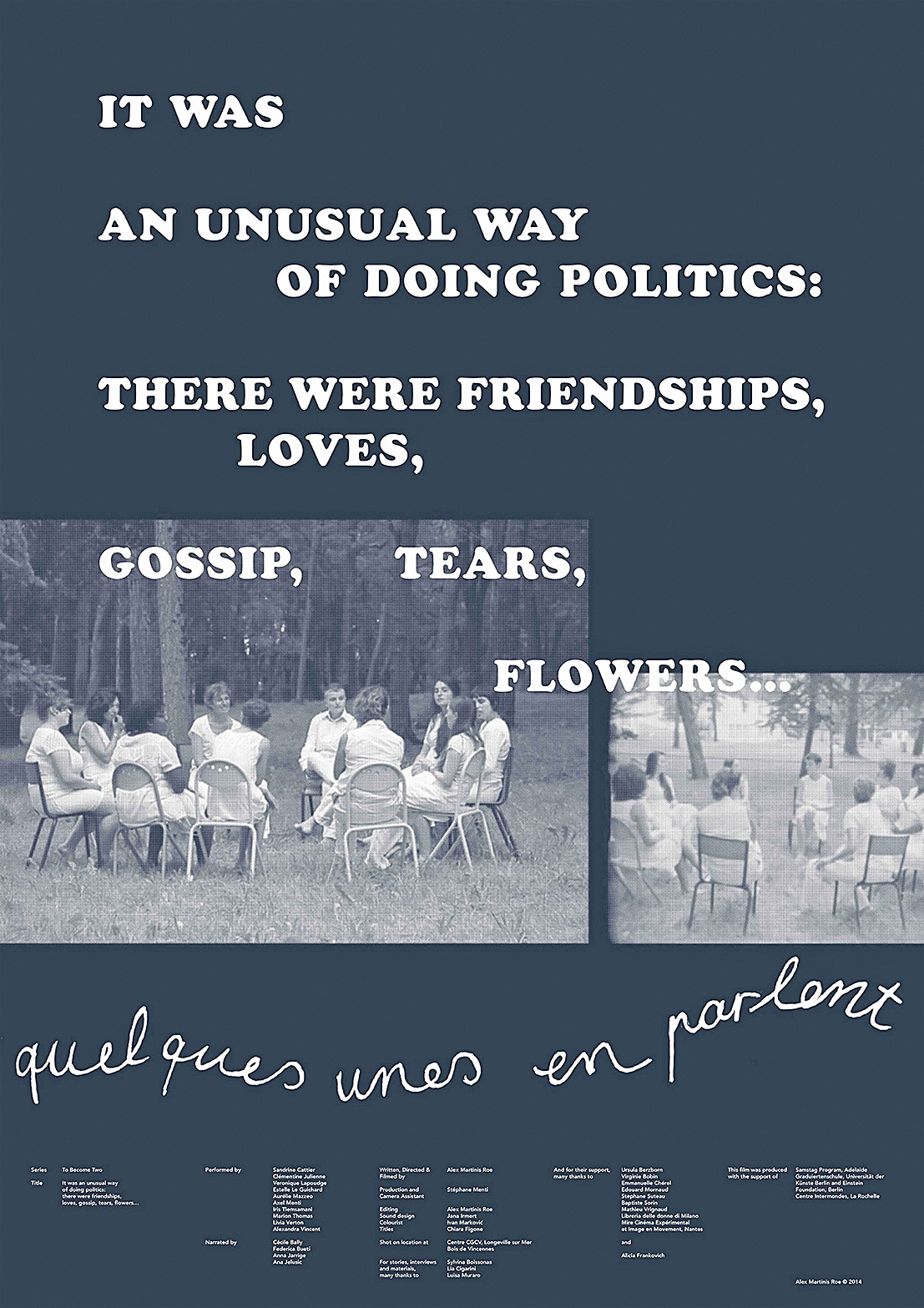
Alex Martinis Roe and Chiara Figone, “To Become Two,” 2016
In a contemporary global scenario in which purposive anonymity, which is to say not the general anonymity of the public but an intentional form of veiling (masks concealing masks to produce social effects), serves the extreme right as much as the democratic center and the radical left. In the United States, ICE agents have picked up the tactics once associated with the black bloc. In the ever-multiplying pleats of social contention in which strategies and tactics are not tethered to any particular ideology or struggle, and where ideologies and struggles multiply just as rapidly, a socially responsible adoption of anonymity might need to situate itself to prevent its dissolution into de-differentiated nihilism. How might parameters be drawn so that anonymity remains functionally emancipatory and can accomplish its intervention without collapsing into or being captured by its very reverse, the fortification of reaction? The tension between anonymity and a horizon of reference, if not a fixed identity, might protect the aggrieved space.
In Canada at present, the feminist collective Emilia-Amalia offers one notable example of anonymity within collectivity. [6] Formed in 2016 in Toronto, the collective takes its foundational principles from the Libreria delle Donne di Milano (Milan Women’s Bookstore) and the laterally emergent 150 Hours model that began to proliferate in Italy starting in 1974. [7] Derived from the Italian Marxist feminist matrix that emerged in autonomy from the workerist movement – itself staking out autonomy from the Communist party, unions, and other forms of representational politics that had come to betray the worker in favor of profit and power – ’70s feminism in Italy addressed both economically structural and independent, subjective struggles. The Scuola Senza Fine (School Without End) project, featuring nonvocational schools that operated as informal community gatherings, for example, put unlearning and learning before any applied ends. The schools attracted women from urban and rural contexts and across generations and ideological affiliations. They attracted “students” from across the social map of combined and uneven development. They met women where they were.
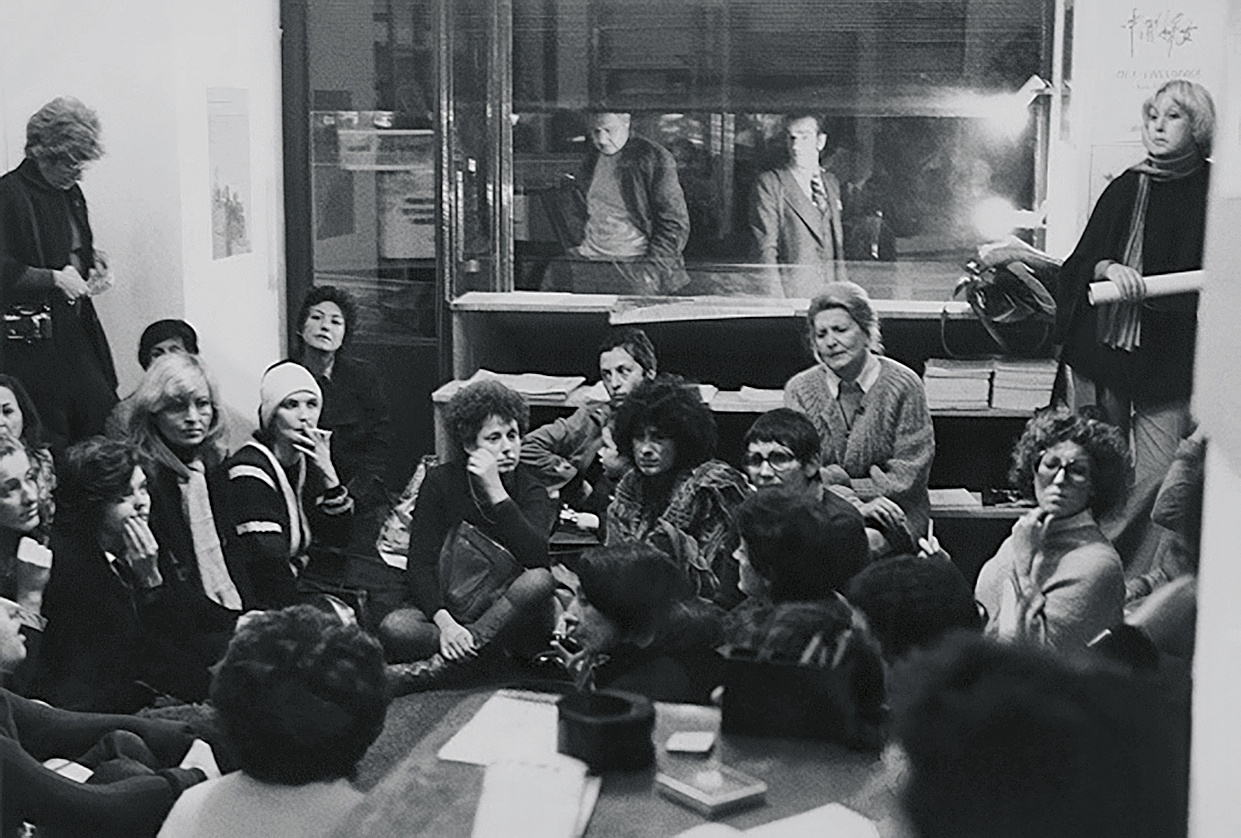
Discussion at the Libreria delle Donne di Milano, ca. 1975
Modeled on a historical phenomenon emergent in the “subversive ’70s,” a central guiding principle for Emilia-Amalia is affidamento, which means to entrust oneself symbolically to the other. This might be a rather ornamental or even rococo way of saying that a practice of intersubjective transference – which already necessitates disidentification from the assignations of the proper socially re/productive “self” – is part of the curriculum. Affidamento is a vehicle of collectivity building. Far from some sort of theory delivered as an intellectual product, affidamento is a praxis honed in exercises that encourage relating across difference and through antagonism. A quick explanation might be to say that gender- and identity-based performativity of the self is suspended in order to affectively perform the other. Unlike psychoanalysis, which hinges on a transferential graft onto the analyst in order to successfully operate, intersubjectivity here travels, indeed transports, within a social field. Its transformational passage is not the movement of a liberated self; on the contrary, its transformative capacity binds women to one another to forge collective identity. This operational capacity is threefold:
One identifies with the other just enough to exit the fixity of identity and imagine thinking through the perceived consciousness of the comrade, who may have arrived at the moment from quite another trajectory. Real mutual aid among women pushes past standard market-oriented liberal career networking by suspending the proper name just long enough to offer substantive support across time, establishing a consistency that is maintained across momentary disagreements, conflicts, and debates, all of which are encouraged by Emilia-Amalia and by the Libreria delle Donne di Milano and Italian Marxist feminist praxes on which it is based, in order to strengthen mutual understanding. Over time, this form of relation becomes a modality of social and political protection. If it is unsafe to intervene into discourse under single authorship, members of the collective simply operate under the name Emilia-Amalia. This is to say that *affidamento* does not encourage a passive collapse into a group identity like a team or a society, a pattern that has been shown to verge on fascism, but that it supports the necessity of social individuation in solidarity elaborated over time (the hours are important) rather than mutual suspicion or competition. On its website, Emilia-Amalia is keen to present its members as specific and singular persons. [8] When a particular member wishes to work under her own name, she is given this freedom – no questions asked. However, when that individuated person experiences threat or violence, including hate speech, others step in to cover her with either collectivity or anonymity, as the situation requires. We all dressed up like wolves and we looked fire.
Authorship can be instrumentalized to isolate, separate, and shame a woman as ruthlessly as the kitchen, bedroom, or late capitalist domestic interior space separates and isolates her. [9] Key here is the way in which identity politics, while respected for its intervention into hegemony and contribution to debate, if not necessarily to liberation, is shelved to enable bonded camaraderie permissive of tension. Emilia-Amalia includes women of several different racialized backgrounds. It would be disingenuous to say that these differences internal to the current composition of Emilia-Amalia do not matter, or that they are a neutral reflection of the larger ethnic composition in Ontario or Canada in general. It would be equally insincere to claim that this range of identities is not purposive or not intentionally enriching. But it would be equally false to say that such an approach to inclusion and diversity is an instrumental or “tokenizing” strategy. Instead, the composition of the collective to incorporate a range of cultural backgrounds is a way to actualize affidamento as a means to diversity and inclusion while also jettisoning the atomizing effects of identity. The point is to dissolve the totality of gendered domination rather than to jockey for position within it.
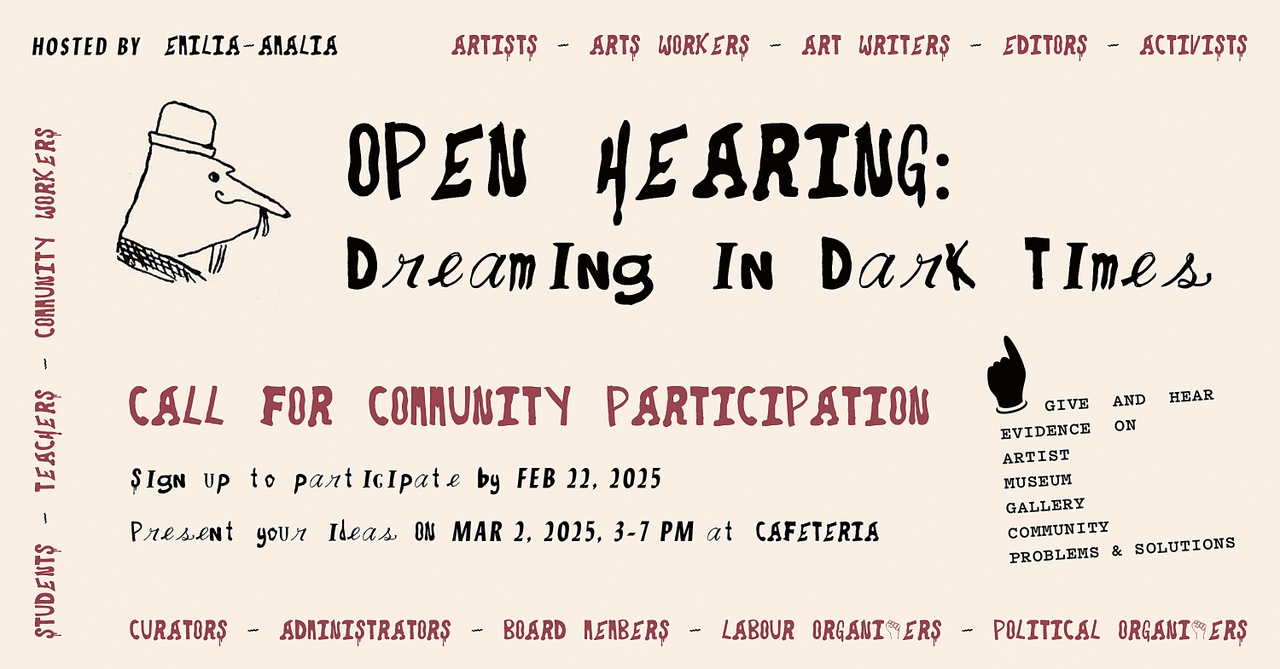
Cecilia Berkovic, “OPEN HEARING: Dreaming in Dark Times,” 2025
This last capacity has been especially acute for Emilia-Amalia. A vivid example might be its para-institutional stance. The women who comprise Emilia-Amalia are affiliated with or employed by the academic, public, private, and not-for-profit sectors. Emilia-Amalia is autonomous from all these sectors. It is self-organized and self-run. This matters at a moment when some institutions seem to have forgotten both their anonymous public and their individuated artists in order to serve the much more pernicious dehumanizing anonymity of capital. To quote Emilia-Amalia member Gabrielle Moser, “Institutions no longer need artists to operate and they no longer need the public.” [10] This is because if one artist is not obedient to a board’s interests, they can easily be replaced by an equally respected artist in an economy of infinite substitution, a chain of exchange. The public, in the meantime, has long remained an aporia in relation to institutions of the public sphere.
To concretize this situation by example, a particular case: In 2022, the National Gallery of Canada (NGC) abruptly fired four senior curators, one of whom was the institution’s first Indigenous curator and had worked for the cultural state apparatus for almost a quarter of a century. [11] While Greg A. Hill, the senior curator who was also Indigenous, a subject position that the state apparatus is continually claiming to support and often tokenizes, protested the sheer hypocrisy of the pretext for this dismissal (so-called restructuring) on social media, he was limited by a nondisclosure agreement. Given the number of women in Emilia-Amalia who are also curators or who occasionally contract with the NGC and other such satellite ideological state apparatuses or who receive state funding, the collective format has afforded a means by which to discuss the instances of political violence or social injustice of the state-run cultural scene under the protective cover of collective authorship while at the same time remaining responsible to a horizon of meaning. This is to say that a totally anonymizing nom de plume is less the strategy than a collective form of action is – one that synthesizes social responsibility with resistance to managerial and ideological pressure from institutions and corporations. The latter tactic entails a form of authorship that hovers somewhere between anonymity and pseudonymity-in-solidarity.
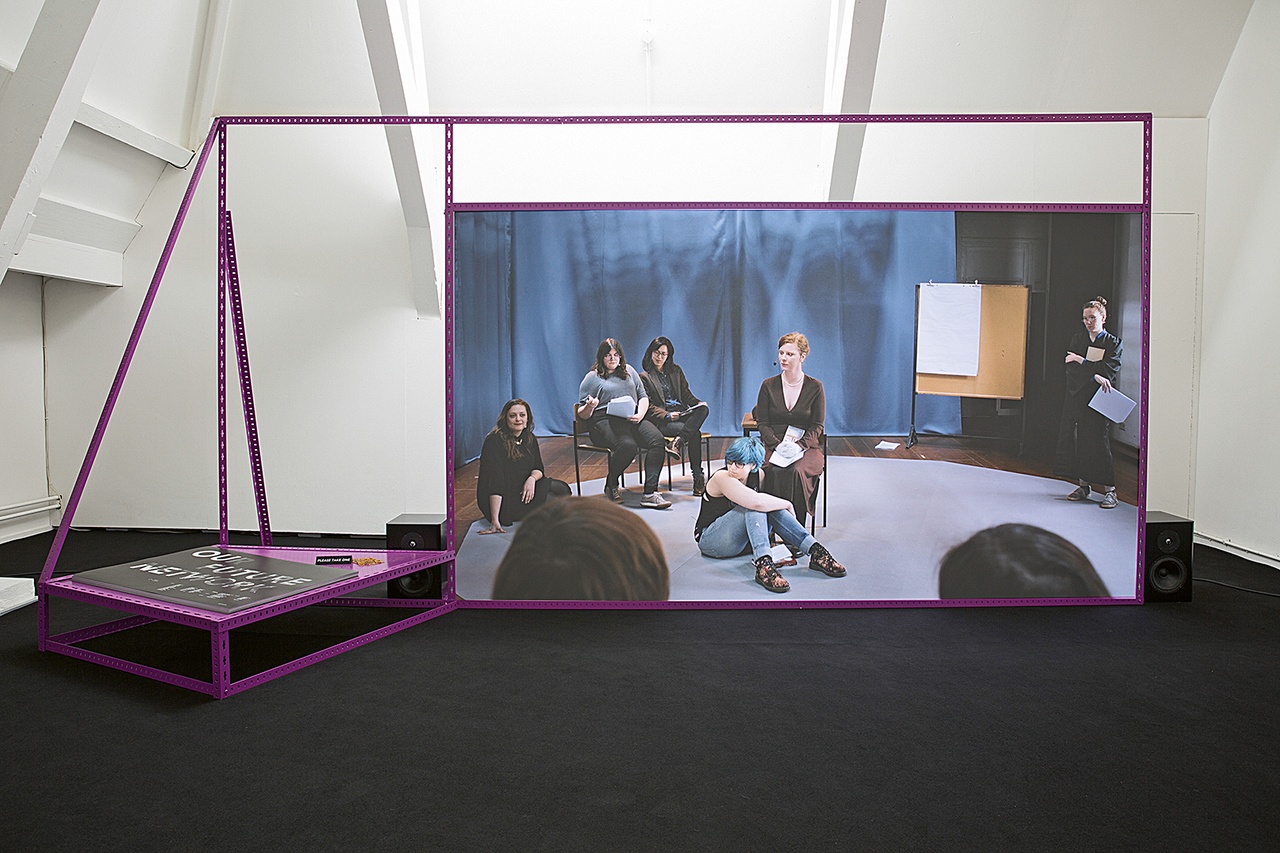
“Alex Martinis Roe: To Become Two,” Casco – Office for Art, Design and Theory, Utrecht, 2016
And so Moser’s critical assessment of the capital circulation that persists owing to the indifference of institutions to their stated aims of making progressive citizens is not “aimed” exclusively at any one corporation, state apparatus, or institution but rather at an aggregate of numerous instances specific to this current cultural, social, and political-economic juncture. Here, any particular concrete case is a fragment of a totality in which no one institution or person exemplifies the current state of hegemony. There are many symptoms, but none aggregate to the level of clarity for a public. And yet very few, if any, scholars, critics, or artists in Canada, other than those immediately involved, have risked an open address with regard to the rupture at the National Gallery of Canada, or to any others like it. [12]
Internationally, and in North American in particular, this conjuncture has been long in formation. The New Yorker referred to it as the McGuggenheim effect in 2008. [13] Rosalind Krauss identified the museum as a vehicle of state-to-capital interests in “The Cultural Logic of the Late Capitalist Museum,” an essay published in 1990 riffing on Fredric Jameson’s Postmodernism, or, The Cultural Logic of Late Capitalism, originally published in 1989. [14]
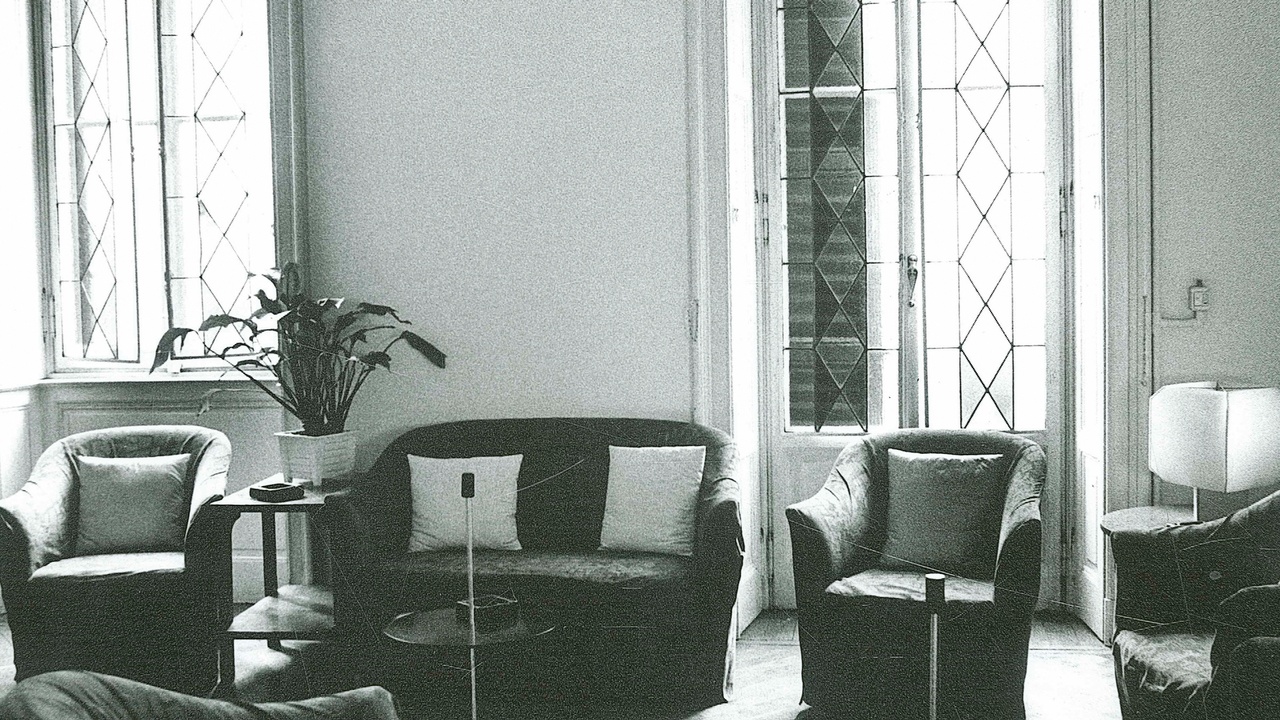
Alex Martinis Roe, “A story from Circolo della rosa,” 2014
In a cultural field of exchange, substitution and fungibility are serviceable to a market-state that begins to treat the worker as a precarious or gig worker, in manifest contradiction to the forms of social responsibility to either publics or artists once assumed to be the ideological role of the institution. The anti-democratic behavior of the board of the NGC echoes any number of US institutions that have capitulated to governmental pressure or begun to resemble corporations rather than bulwarks against market-motivated social indifference. Instances range from the McGuggenheim effect to national museums in Washington, DC, that have agreed to edit wall texts and contextual information about cultural objects, to universities and newspapers. [15] The Canadian difference is that, whereas most cultural organs in the United States are either privately funded or run on the fumes of a precarious assemblage of private and public funds, most mainstream art in Canada is almost entirely state supported. Obviously, this social-democratic model is ideal until culture comes to be used as a form of governance and ideological messaging.
Key to Emilia-Amalia’s responsive tactic is the degree to which it advances a kind of shield without totally relinquishing social responsibility. If anything, it picks up the responsibility to an anonymous public that the institution has relinquished. This mobilization of anonymity supported by a framework of horizontal collectivity of necessity remains distinct from state or corporation, from power or brand. It also countervails empty aleatory despair or atomized forms of anonymity that come to be, consciously or otherwise, mimetically inscribed in social abstraction. But this requires enough trust, good faith, or transferential empathy. To stand firm and clear of instrumental reason, self-interest, servitude to the state, or value form demands fortitude of an altogether different level of conscious praxis. But precisely this practice of support is direly necessary in moments of social pressure, duress, and oppression, which is to say now, when institutions of the bourgeois public sphere no longer protect free speech but cast their lot in with market authoritarianism, itself masked within respectability politics and cancel culture.
Jaleh Mansoor is a professor of modern and contemporary art at the University of British Columbia. Her areas of interest are formalism, Marxism, and Marxist feminism.
Image credit: 1. Courtesy the artist, 2. Courtesy the artists, 3. For this image, the editors have made every effort to get in touch with the copyright holder. Should any claims remain unresolved, please contact TEXTE ZUR KUNST. 4. Courtesy Cecilia Berkovec and Emilia Amalia, 5. Courtesy the artist, photo Niels Moolenar, 6. Courtesy the artist and the Milan Women’s Bookstore co-operative
Notes
| [1] | Alberto Toscano, “The Open Secret of Real Abstraction,” Rethinking Marxism 20, no. 2 (2008): 273–87, at 274: “‘Capitalist’ means a man transformed into a mask, into the person of capital: in him acts capital producing capital […]. The abstract, in capitalist society, functions concretely.” Toscano cites Roberto Finelli’s Astrazione e dialettica dal romanticismo al capitalismo (saggio su Marx) (Bulzoni Editore, 1987), where Finelli is careful to qualify the degree to which this “mask” is not casually donned or discarded but becomes the very “real” available to appearances: “Abstraction [is] not a mere mask, fantasy, or diversion, but as a force operative in the world.” Toscano also cites Jacques Rancière’s “The Concept of ‘Critique’ and the ‘Critique of Political Economy,’” in Ideology, Method and Marx, ed. Ali Rattansi (Routledge, 1989). |
| [2] | Amy De’Ath, Behind Our Backs: Feminized Poetry and Capitalist Abstraction (Stanford University Press, 2026), 12. |
| [3] | Michel Foucault, “What Is an Author?,” in Language, Counter-Memory, Practice, trans. Donald F. Bouchard and Sherry Simon (Cornell University Press, 1977). This text was first published in French in 1969. See also Molly Nesbit, “What Was an Author?,” Yale French Studies, no. 73 (1987): 229–57. |
| [4] | Theodor Adorno, The Jargon of Authenticity [1964] (Routledge, 2006). |
| [5] | Asad Haider, Mistaken Identity: Mass Movements and Racial Ideology (Verso, 2022). |
| [6] | Gabrielle Moser, “Affidamento as Curatorial Methodology: Feminist Approaches to Pedagogy and Curating in the Work of Emilia-Amalia,” Journal of Curatorial Studies 12, no. 2 (2023): 258–88. |
| [7] | On the range of positions and voices configuring the Marxist feminisms of the Italian 1970s, see Arlen Austen, Sara Colantuono, and Jaleh Mansoor, Gendered Labour and Clitoridean Revolt: Carla Lonzi and Leopoldina Fortunati, Folio Series (Fillip, 2024). On the Scuola Senza Fine, see “Scuola Senza Fine – School Without End: Italian Women and the 150 Hour School Diploma Course,” Feminist Duration Reading Group, 2016. |
| [8] | See https://www.emilia -amalia.com/about/. |
| [9] | On overcoming forms of separation required by mid-to-late-20th-century capitalist patriarchy, see Selma James and Mariarosa Dalla Costa, The Power of Women and the Subversion of the Community (Falling Wall, 1972). There are numerous reprints. It circulates as a pamphlet in autonomous spaces, women’s bookstores, and in online PDFs. |
| [10] | Gabrielle Moser, “Boycotts as Openings,” paper presented at the public roundtable “Refusals and Practices of Freedom,” Università degli Studi di Palermo, May 15, 2026. |
| [11] | News Desk, “National Gallery of Canada Abruptly Fires Four Senior Curators,” Artforum, November 21, 2022. |
| [12] | Curator Kitty Scott has articulated what she could of the situation; see Larry Humber, “Canada’s National Gallery Abruptly Lays Off Four Senior Staff, Including Chief Curator and Indigenous Art Curator,” The Art Newspaper, November 21, 2022. |
| [13] | Andrea K. Scott, “The McGuggenheim Effect,” New Yorker, August 12, 2008. Scott refers to both the physical expansion of the museum after the Guggenheim multiplied beyond its second branch, in Bilbao, to build a branch in Abu Dhabi, having scrapped plans for Rio de Janeiro, St. Petersburg, Taiwan, and Singapore, as well as to its programming, which former director Thomas Krens explicitly referred to as a strategy through which to build a brand rather than a cultural institution, a logic Scott identifies as in keeping with the franchise model of fast-food restaurants such as McDonald’s. |
| [14] | Rosalind Krauss, “The Cultural Logic of the Late Capitalist Museum,” October 54 (1990): 3–17. For a technical analysis of how museums act as corporations aggregating wealth for wealthy collectors (often their own board members) under the mask of philanthropy, see Nizan Shaked, Museums and Wealth: The Politics of Contemporary Art Collections (Bloomsbury, 2022). |
| [15] | The White House, “Letter to the Smithsonian: Internal Review of Smithsonian Exhibitions and Materials,” August 12, 2025. This cultural and ideological confrontation is currently under review in the US judicial apparatus at a federal level. |