
PRIVATE CRITICISM, PUBLIC PRAISE A Response to Béatrice Grenier, Emanuele Coccia, and Chris Dercon by Arnaud Esquerre
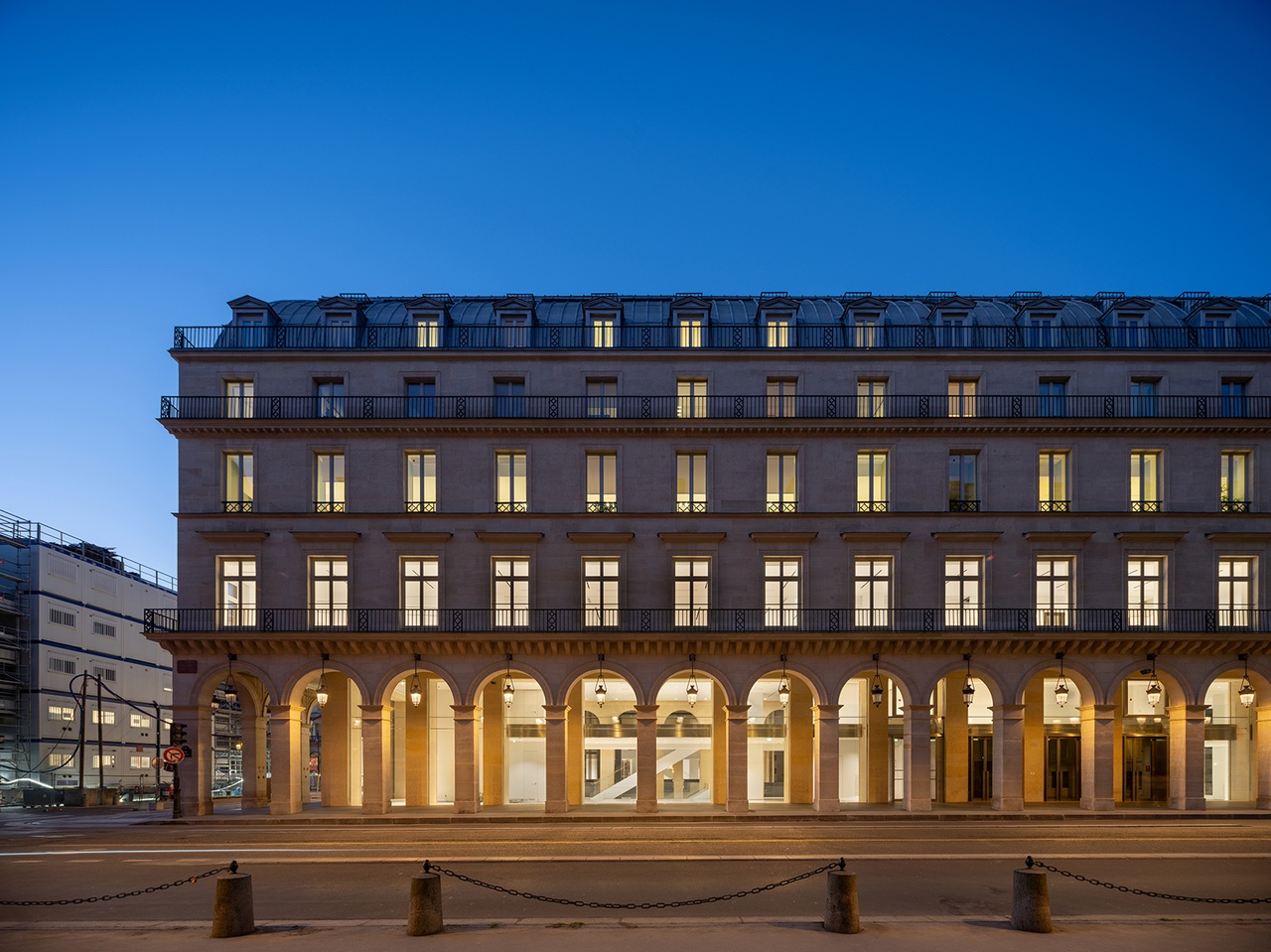
Fondation Cartier, Paris, 2025
After the publication of “The Permanent Fair,” my review of the inaugural show of the then newly reopened Fondation Cartier, what surprised me most were the reactions of people from the contemporary art world whom I know and who had read it: All of them told me, in confidence, that the text had put into words what they thought about the new Fondation Cartier, but that they did not dare say so publicly. One of them, after telling me that she fully agreed with what I had written, concluded: “But this text is a suicide.” This statement initially astonished me and left me puzzled, because I didn’t feel that I had committed an act against myself. What she meant, however, was that if she herself had published this kind of statement, her career would have been over, and she would no longer have been invited to curate exhibitions, write texts for catalogues, or even attend vernissages.
The text by Béatrice Grenier, Emanuele Coccia, and Chris Dercon in response to my article doesn’t really challenge its main thesis, namely that the new Fondation Cartier has the morphology and functioning of “a permanent fair.” The authors leave untouched my description of the visitor’s experience. Instead, their response seeks to shift the discussion toward art history and sociology. Since I am not an art historian, I will leave it to art historians to examine the quality of those arguments. I would nevertheless like to clarify that I didn’t write that fairs began with Art Basel, but rather that since the founding of Art Basel, contemporary art fairs have proliferated, as Nathalie Moureau has shown [1] . I will, however, respond to their lesson in sociology, which left me perplexed. A sociological analysis doesn’t consist merely in adopting the categories by which an institution describes itself, but in analyzing the gap between those categories and what the institution actually produces.
The Grenier, Coccia, and Dercon text appears to oscillate between two contradictory positions, or at least between two positions in strong tension. On the one hand, the thesis that the Fondation Cartier is “the permanent fair” seems to suit them perfectly, and I would merely have repeated, in different words, what was already expressed in the very title of their exhibition. But, if this is indeed the case, the authors should rather welcome my analysis, and one wonders why their response is so vehement. On the other hand, however, they argue that the density of objects in the Fondation Cartier’s space resembles Surrealist exhibitions rather than the contemporary art fair, and that “culture is priceless.”
Grenier, Coccia, and Dercon also accuse me of elitism, as if I believed that the contemporary art museum should not attract large audiences. I have, of course, never written anything of the sort. Rather, I have pointed to the opposite problem: The current design of the Fondation Cartier doesn’t allow visitors to contemplate works, let alone understand them, because I argue that it is instead modeled on the contemporary art fair, where visitors who are most accustomed to fairs and highly familiar with contemporary art can move from one artist to another, even when there is no obvious relationship between them, because members of this elite know perfectly well how to situate them, often being collectors or professionals within the art world.
The core of their attack concerns my supposedly narrow and simplistic opposition between public and private, my reduction of actors’ motivations to economic interests, and my denunciation of a “Gnostic god called capitalism.” This view is presented as already contained in Enrichissement, a book I coauthored with Luc Boltanski, which they describe in quotation marks as a “Bourdieuism for the uninitiated.” Yet Pierre Bourdieu notably emphasizes differences in aesthetic taste as a principle of social distinction and developed the concept of cultural capital. In Enrichment, by contrast, the difference is supported by things, not by people, and it is by no means a principle of social distinction, but rather a way of generating surplus value by exploiting these things. There is no reference to cultural capital, but there is indeed a reflection on capitalism, understood as the unlimited accumulation of capital, and on economic inequalities which, for us, but surely not only for us, are not illusions but realities in contemporary society.
Very often, whatever position an artwork assigns to the spectator, whether it is closed to their presence or absorbs them by making them enter into it, the spectator is treated as someone who looks at it without maintaining any relationship with its economy. Conversely, the owner of an artwork appears to have purchased it while paying attention only to its dimensions, its state of preservation, the artist’s name, and its market value, without having looked at what it represents. Symmetrical to the non-commercial artist being set in opposition to the commercial artist, the spectator would always be disinterested, whereas the buyer could only be interested. This opposition persists when collectors present themselves above all as spectators, passionately attached to their objects, as “friends” of gallerists, thereby distancing themselves from the commercial act they carried out in order to acquire the works, as if thinking about it were secondary, or even degrading.
Our work has been to reintroduce the question of price. Yet, predictably, Grenier, Coccia, and Dercon act as if this question had no importance. Art historians Sophie Cras and Charlotte Guichard, in an important recent book about the primary market [2] , have shown that the question of the price of artworks leaving the artist’s studio has, of course, been a central concern for artists since the Renaissance, and how its justification and negotiation have varied over the centuries. They date the generalization of the French term cote (the artist’s market valuation) to around 1900 and show how, whatever the market – primary or secondary – the establishment of market value has removed, if not entirely, at least to a very large extent, artists’ ability to set the price of their own works. Of course, neither Cras and Guichard nor Boltanski and I claim that it is “price that drives actors to engage in the cultural sphere.” But, as art historians and sociologists, we examine the place of the price of artworks and their value.
The issue isn’t so much the condemnation of an “inhuman quest for profit.” The question is how profit, if there is any, is distributed. Why should it be captured by luxury companies, their owners, and a handful of gallerists, curators, and star artists? Why could there not be a less unequal distribution? If artists wish to regain the ability to set their own prices, how can they establish relationships with buyers by emancipating themselves from intermediaries, when a large proportion of them sell artworks only sporadically? Why does a foundation that presents itself as having invented a new form of exhibition and operation merely extend the model of the art fair?
This is the paradox revealed by the response of Grenier, Coccia, and Dercon: Today, Paris has an artistic and cultural life of extraordinary intensity, as the Fondation Cartier itself demonstrates, and perhaps Paris has once again become the world capital of art. But it’s almost impossible to make any critical statement about what’s happening there. It is not that critical theory is lacking: On the contrary, many artists and exhibitions draw on theories of race, gender, ecology, and so on, and even invite academics to highlight their work. But it’s difficult, if not impossible, to articulate a critical discourse about works, exhibitions, artistic events, and their economy. For example, feminist criticism is valued when it’s directed outward, but it remains difficult to express when it concerns the contemporary art world itself. Artworks, exhibitions, art foundations: Publicly, everything is either praised or criticized only “between the lines.”
I believe that the only openly critical text on contemporary art that I have read in Le Monde in recent years (and one should acknowledge that the newspaper gives “criticism” considerable space) concerned Laurent Fabius. [3] This politician decided to become a painter, which demonstrates, in another way, the supreme value accorded to art in France – as if, after having been Prime Minister, President of the National Assembly, and President of the Constitutional Council, this were the only distinction still missing from his career. At the age of 79, he held an exhibition of his paintings in a Parisian gallery, and Le Monde’s review dealt with it in a devastating – and, it must be said, rather amusing – way. But this was because criticizing him had no consequences for the journalist’s position and, on the contrary, reinforced the closure of the contemporary art world by signaling to Fabius that he could never be part of it as an artist.
I have worked in recent years on “censorship” and, contrary to claims from the political right and far right according to which “one can no longer say anything” because of feminist, LGBTQIA+, environmentalist, or anti-racist movements, I have argued that we have never been able to speak as freely as we can today in a democratic state such as France [4] . I now realize that I should perhaps have refined my analysis and that, concerning the contemporary art world and the luxury industry, this isn’t true. It’s very difficult, if not impossible, to criticize it from within, particularly regarding the relationships between contemporary art, the luxury industry, and art critics.
Starting from the Fondation Cartier, my article sought to raise questions about the economy of contemporary art and its consequences for the ways in which artworks are displayed. These questions do not disappear simply because they are considered unwelcome within the contemporary art world in France today. On the contrary, they are all the more important because they are rarely discussed publicly.
Arnaud Esquerre is a sociologist at the École des Hautes Études en Sciences Sociales (EHESS) in Paris and at the Centre National de la Recherche Scientifique (CNRS).
This text has been written in response to this text by Béatrice Grenier, Emanuele Coccia, and Chris Dercon. The review "The Permanent Fair" by Arnaud Esquerre can be found here.
Notes
| [1] | “Whereas at the beginning of the 21st century the number of art fairs worldwide was still limited – around twenty – the movement accelerated over the past twenty years, and today there are more than 250 international fairs, 56% of which are in Europe,” Nathalie Moureau, Les foires, quelles opportunités pour les galeries? (Comité Professionnel des Galeries d’Art, 2018, 5). |
| [2] | Sophie Cras and Charlotte Guichard, Vendre son art (Le Seuil, 2025). |
| [3] | Roxana Azimi, “Laurent Fabius, peintre, voit son art comme ‘un partage d’émotion,’” Le Monde, June 13 2026 https://www.lemonde.fr/culture/article/2026/06/13/laurent-fabius-peintre-voit-son-art-comme-un-partage-d-emotion_6701632_3246.html. |
| [4] | Arnaud Esquerre, Liberté, vérité, démocratie (Flammarion, 2025). |