
ON THE NEW FONDATION CARTIER AND THE “EXPOSITION GÉNÉRALE” A Response to Arnaud Esquerre by Béatrice Grenier, Emanuele Coccia, and Chris Dercon
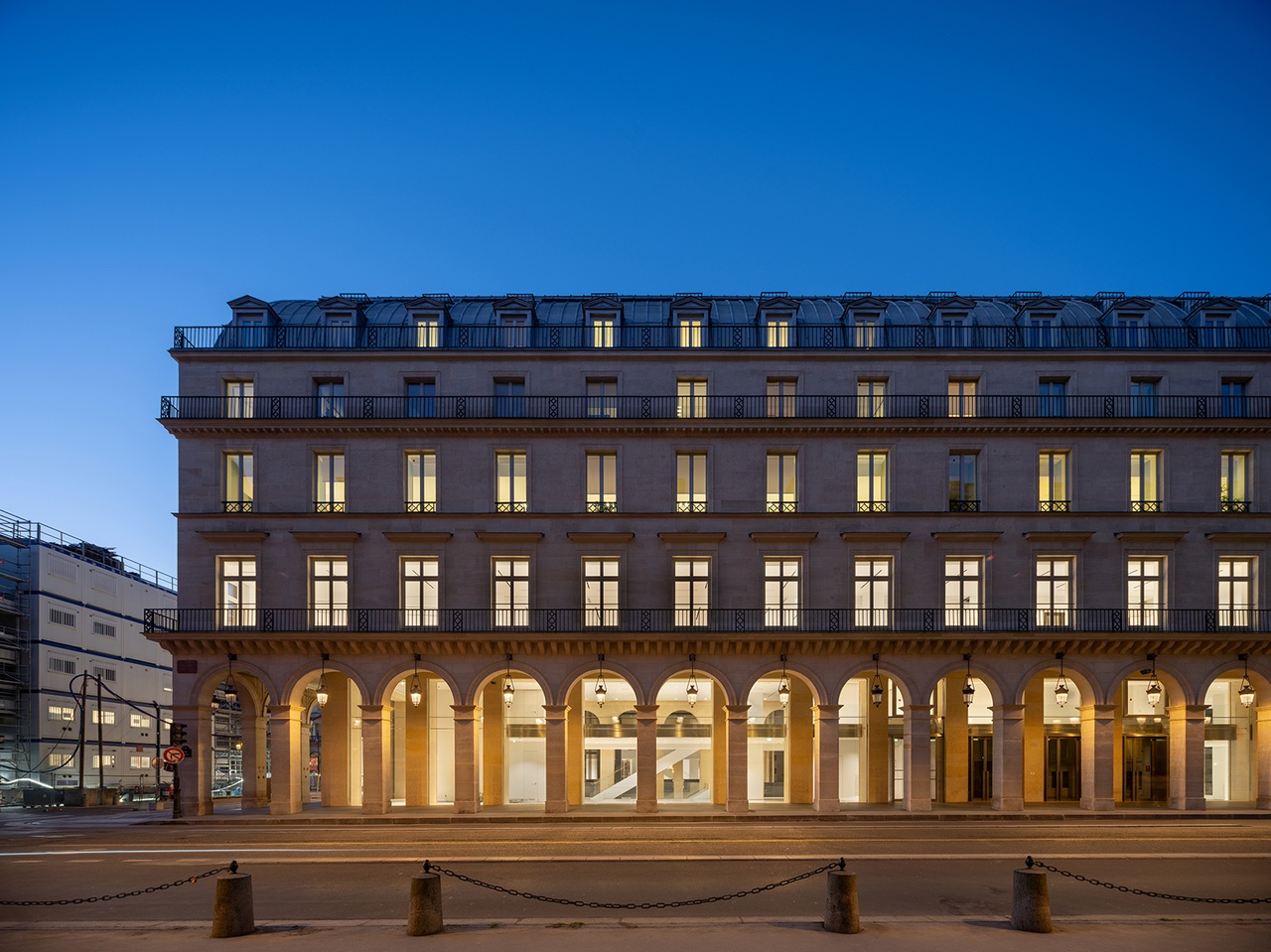
Fondation Cartier, Paris, 2025
The recent review by Arnaud Esquerre of the inaugural exhibition of the new Fondation Cartier, which recently opened across from the Louvre in a former department store transformed by architect Jean Nouvel, ignores the history of contemporary art, the history of museums, and the art market to put forth a critical agenda. While the assessment of the “Exposition Générale” exhibition may remain negative, some factual corrections are in order.
Esquerre’s argument is a poor syllogism: that “Exposition Générale” mistook a museum space for an art fair – even in its spatial organization – and thus defiled the cultural purity of every form of artistic enjoyment. The implicit premise of the syllogism is even more disheartening: that the Fondation Cartier can be accused of having enlisted itself in the army of evil simply because the author firmly believes that art fairs are monstrous incarnations of a Gnostic god called capitalism, in which all cultural logic is abandoned in favor of an inhuman pursuit of profit. What is most striking about these thoughts is, first and foremost, the lack of contextualization. Apparently, for example, it was of little use that the exhibition’s title and more than one text in the catalog explicitly referred to the very long history of the fair and the exposition universelle as the mechanism that the exhibition appropriates: The mere association of museum and fair is, for the author, a source of such severe discomfort that he fails to realize his critical argument is a tautological elaboration of the exhibition’s title itself. The problem is that what is considered intolerable from the author’s point of view is the very history of art fairs. The author traces the rise of art fairs to the founding of Art Basel – which was, in fact, already a response to the Art Cologne founded by Rudolf Zwirner and Hein Stünke in 1967 as the Kölner Kunstmarkt – apparently ignoring that the model is obviously much older. Art Basel and the Cologne art fair merely reuse a model that had become institutionalized in Paris in 1855 (and, incidentally, in that very same building that now hosts the Fondation Cartier – as the catalog amply demonstrates), when the World Fairs peacefully and definitively adopted commercial aims. Beyond the curious (and false) presumption that art fairs are what establish a link between art, its exhibition, and the market – as if such a link did not exist before – and the (equally false) image of the museum as an institution entirely detached from these kinds of dynamics, it is serious that the author ignores or glosses over how much these institutions have contributed to the modernization of cities, to the democratization of knowledge, and above all to the invention of the cognitive and architectural display mechanisms that museums later adopted. It was Georg Simmel, at the end of the 19th century, who had already demonstrated that museums and art centers had long since inherited the spatial and display structure invented by trade fairs. It is especially thanks to this interaction that museums began to envision a pedagogy different from the purely scholastic approach tied to chronology and the “period room.” This, too, is a fact that has been not only established but also surpassed by the history of museography and museum architecture for nearly 170 years – a fact the author also ignores. The Fondation Cartier project is part of a long modern-postmodern tradition in museum architecture – from Richard Meier to Philip Johnson to Robert Venturi – that had already made Brian O’Doherty’s critique of the “white cube” mainstream, a concept that had already been superseded by the Guggenheim in New York and thereby entered popular culture. To imagine that the project of the Fondation Cartier reacts to the “white cube” as if it were still a dominant mode of display in museums is equivalent to ignoring the past half century of museographic and architectural innovation in the typology of museums. This is unacceptable. If form were truly what mattered to the author, Esquerre might have dwelled more on the fact that Nouvel’s architecture opens up the space to free the museum from the palatial logic of the encyclopedia, places the various modes of expression on an equal footing, abolishes cultural hierarchies, and opens the museum to the street – thus directly countering that very logic of the fortress-museum inherited from private salons, aristocratic societies, and the elitism that Esquerre paradoxically laments. As for the density of objects in space, this is a completely ordinary device that the Surrealists had already employed in their exhibitions a century ago. The “density” of display in “Exposition Générale” provides dialogues and juxtapositions between different works considered to belong to different disciplines, which in traditional museums are separated. These divisions became only apparent through the “invention” of new art histories in museums in the late 19th century.
In reality, the opposite movement has also been underway for more than a century: As Frederick Kiesler wrote at the dawn of the 1930s, American department stores had taken on the role of great museums of contemporary art, capable of bringing beauty and culture to the masses – who might not otherwise have access to them. It is therefore curious, to say the least, to note the annoyance with which the author seems to view museums that succeed in becoming a means of mass communication. Attracting the masses is the museum’s educational role – Why does a university professor consider this a flaw? Such a Manichean opposition between public and private not only betrays a quintessentially French view of the contemporary cultural ecosystem in which, to the contrary of the author’s shallow assessment, the plurality of funding sources actually fosters healthy dialogue, stimulates necessary competition to raise cultural standards, and multiplies opportunities for artists, but it also points to the author’s bias. This is a mistake which the discipline of sociology, in a seminal work by Émile Durkheim, had warned against early on in Les règles de la méthode sociologique (1895). Instead of attempting to identify the true nature of the collection of the Fondation Cartier, and thus the cultural implications of this institutional form, Esquerre distorted the reality to advance his critical agenda. This was Durkheim’s warning, about those “ghost-like creatures that distort the true appearance of things and which we nevertheless mistake for the things themselves.” Had Esquerre conducted an investigation, with primary research on the Fondation Cartier’s program and collection, he would have understood that advancing his argument was impossible. As is stated in many texts of the exhibition accompanying works on display, most works in the collection were also commissioned and produced by the Fondation Cartier itself. The result is that for most works, such as architectural models, works by non-professional artists, in addition to works produced in the context of exhibitions, have an archival status rather than a market value. This is the very reason why the sections of the exhibition are titled after past exhibitions of the Fondation Cartier: The collection is as much a series of objects and artifacts as it is an archive of the institution’s past program. The introduction to the exhibition titled “Machines d’Architecture” for example displays a portion of the collection that is devoted to architecture: A model by Bodys Isek Kingelez displaying a utopian view of Kinshasa in the third millennium, a model chapel by radical Italian designer Alessandro Mendini in mosaic crafted in Bisazza, and a model in plaster walls by architect Junya Ishigami, replicated specifically for this exhibition. Both the selection and very nature of the works couldn’t be further away from showcasing a market-driven collection and even less probably be an advertisement for a sale.
This reveals the unquestioned premise underlying Esquerre’s entire argument – his “Bourdieuism for the uninitiated,” already present in his monograph Enrichissement (2017) written together with Luc Boltanski: the idea that art has no clear economic value and that, therefore, the motivation for collecting is always and only a logic of profit-making, and never respect for the objects or for their paradigmatic value in terms of cultural artifacts. The fact that the sociologist mechanically applied an analysis – originally based on objects that are, all things considered, quite basic, such as Laguiole knives – to art collections demonstrates precisely this: Esquerre has a poor idea of how to objectively distinguish the cultural value of different objects. Ignorance of art history cannot be mobilized as evidence within sociological analysis. The fact that the cultural value of an object cannot be translated in a stable and definitive way into economic value does not mean that cultural value lacks any objectivity. Nor does it mean that the behavior of those who intend to collect or exhibit these objects is motivated by mere profit motives. If culture is priceless, it is not price that motivates actors to engage in the cultural sphere. To claim the opposite is not to engage in science; it is to mistake one’s own nihilism and cynicism for cultural evidence – one’s own ghosts for contemporary culture.
Emanuele Coccia is an Associate Professor at the École des Hautes Études en Sciences Sociales (EHESS) in Paris.
Chris Dercon is the Director General of the Fondation Cartier pour l’art contemporain.
Beatrice Grenier is the Director of Strategic Projects and International Programs at the Fondation Cartier pour l’art contemporain.
This text has been written in response to the review "The Permanent Fair" by Arnaud Esquerre. His response to this critical reaction can be found here.