
MELVIN EDWARDS (1937–2026) By Zoé Whitley
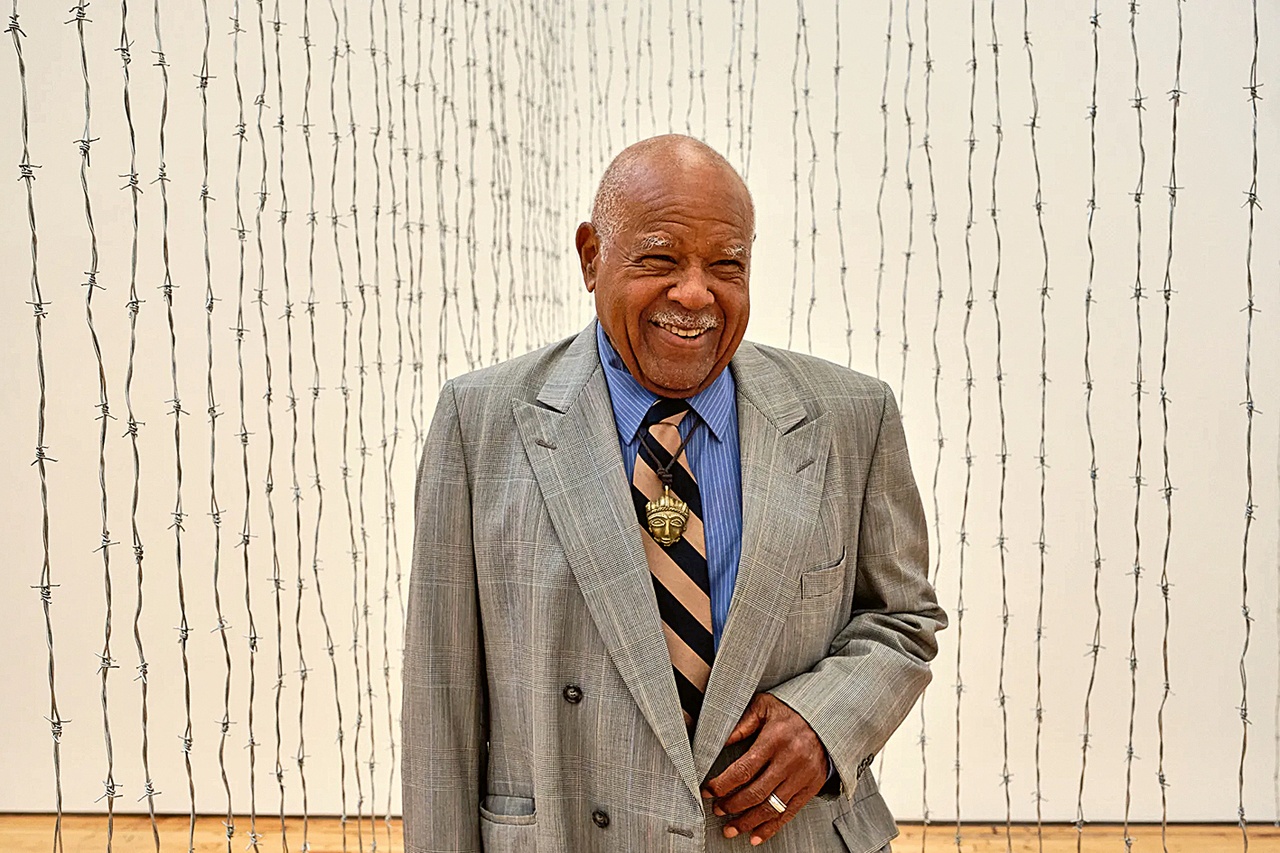
Melvin Edwards, 2022
Melvin Eugene Edwards Jr. was expert in equilibrium and tension. Best known as a sculptor of welded steel, he initially trained as a painter and concurrently maintained a vibrant, lifelong drawing practice. A knowing, witty contrarian with a rapier mind and equally sharp sense of humor, Edwards always held in equal balance art’s quotidian points of reference, real-world cultural import, and subtle formal qualities. As he was never one to be pigeonholed, the quickest way to earn an astute elaboration from Edwards would be to focus for too long on the social, to the neglect of the structural, or vice versa. To linger over the sheen of welding joins as bas-relief would elicit a master class in how the hardness of metal could in fact be reinterpreted as welts or keloid scars on a brutalized body. To dwell on the visceral power of chains in the arc of Black enslavement warranted redirection toward the materiality of interlocking forms, toward positive and negative space coexisting in a repeat pattern, and toward a brief history lesson on Benin metalsmiths’ transformative innovations for devising stronger mechanisms than brittle rope for crop harvesting. Never either/or, always both/and, Edwards’s art was simultaneously poignant and industrial, cerebral and innate.
He was born in Texas and displayed real athletic talent from early on, going on to play for the state-champion team in American football at Houston’s Phillis Wheatley High School, named after the abolitionist and first African American published poet. Edwards went on to play football for the University of Southern California, where he studied art. His formative years predated the tired but pernicious later 20th-century pop-culture stereotype where intellect and athleticism are presented as mutually exclusive: Edwards perpetually credited his foundational understanding of spatial abstraction to the complex strategic diagrams of American football playbooks, which taught him to translate symbols into actions. These maneuvers he likened to a choreographic score, as evidenced in sublime freestanding works he would later create, such as Dancing in Nigeria (1974–78), where intersecting lines appear to arc and pivot in space. He understood translating horizontal and vertical planes into new three-dimensional configurations in relation to the body. Edwards himself observed, “When I first started trying to find more experimental or unusual forms to make sculpture […], I would use physical positions related to football.” [1] Highly perceptive, he rejected formalist diktats that espoused art’s disconnection from lived experience. During his undergraduate years in the early 1960s, he furthered his studies at the Los Angeles County Art Institute (today called the Otis College of Art and Design), where he honed his welding skills and subsequently became a faculty member at the Chouinard Art Institute from 1965 to 1967. A proud Black man born in the segregated South and an ardent civil rights activist, he was committed to the physicality and immediacy of form, which led to a breakthrough in 1963: the iconic Lynch Fragments. This enduring series of wall-mounted welded reliefs, hung at the artist’s own eyeline, was initially inspired by the unique mix of pathos, politics, poetry, and pan-African news contained in the quarterly journal Freedomways (1961–85). Edwards excelled at working within and defying constraints, often operating on a modest scale with seemingly infinite variations on form. This he took to be his own improvisatory contribution in the spirit of jazz, where the parameters of recording on 78 rpm or 33 1/3 rpm determined how to, “within limitations, just push further.” [2]
By the late 1960s, Edwards earned recognition for his large painted outdoor sculptures, which he developed after spending time in the company of George Sugarman, credited with innovating pedestal-free sculpture. Among his numerous accolades, Edwards was the first African American sculptor to have a solo exhibition at the Whitney Museum of American Art, presenting a body of work comprising barbed wire and chains, redolent with connotations of subjugation and containment, on the one hand, yet, on the other, existing as highly original post-Minimalist experiments with the syncopated rhythms of manufactured materials. Having seen that 1970 exhibition firsthand, David Hammons credited Edwards as a singular vanguard: making “the first abstract piece[s] of art that I saw that had a cultural value in it for Black people … because I didn’t think you could make abstract art with a message.” [3]
Part of a tight-knit group of long-term friends and conceptual sparring partners including Frank Bowling, Ed Clark, Sam Gilliam, Jack Whitten, and William T. Williams, Edwards even served as best man in Whitten’s wedding ceremony. He was part of Smokehouse Associates (1968–70) in Harlem with fellow artists Guy Ciarcia, Billy Rose, and Williams. Collectively, they painted hard-edged geometric murals on the sides of buildings, with Edwards’s sculptures in neighboring vacant lots. While the urban mural movement of the time was predominantly figurative with motivational messages of hope and change, Edwards’s view was, “We saw the work itself as being the actual change. You don’t tell people to make things better, you make things better and people join you.” [4]
Edwards was a frequent traveler throughout Africa since 1970, together with his wife, the venerated poet and performance artist Jayne Cortez (1934–2012); he self-effacingly referred to himself as her “bag handler” owing to her incandescent recognition internationally. Their creative partnership resulted in works on paper and printed matter such as the illustrated poetry volume Scarifications (1973), which they dedicated in part to Léon and Marietta Damas, leading thinkers in the Négritude movement. In 2000, Edwards and Cortez established a home in Senegal, residing in the Sangalkam arrondissement on the Atlantic coast. There, Edwards collaborated with local metalworkers on iron grid works, further expanding the welding language he made his own. He died at 88 years of age on Monday, March 30, 2026, at home in Baltimore, Maryland. Edwards often wore a West African pendant mask on a leather cord, a symbol of spiritual protection and a perpetual homage to the continent from which his ancestors originated, and to which he was always happy to return.
Zoé Whitley is a contemporary art historian. As a former museum curator (2003–19, at the Victoria and Albert, Tate, and the Hayward), and director of Chisenhale Gallery (2020–25), her work has helped reshape how institutions engage with art from the African diaspora, bringing new, intersectional perspectives into the canon. She is a Rockefeller Foundation 2026 Bellagio Center Residency recipient, the author of a forthcoming major monograph on Barbara Kruger, and Betye Saar’s official biographer.
Image credit: Courtesy Dia Art Foundation, photo Don Stahl
Notes
| [1] | Melvin Edwards in conversation with Catherine Craft, “Conversations with Melvin Edwards: Extended Version,” Nasher Sculpture Center, 2013–15. |
| [2] | Melvin Edwards in conversation with Zoé Whitley, “Brotherliness: Melvin Edwards Reflects on Fifty Years of Friendship with Jack Whitten,” in Jack Whitten: Jack’s Jacks, exh. cat., ed. Udo Kittelmann and Sven Beckstette (Prestel; Nationalgalerie Staatliche Museen zu Berlin, 2019), 133. |
| [3] | Kellie Jones, “Interview with David Hammons” [1986], in Eye/Minded: Living and Writing Contemporary Art (Duke University Press, 2011), 249. |
| [4] | Melvin Edwards quoted in James Prigoff and Robin Dunitz, eds., Walls of Heritage/ Walls of Pride: African American Murals (Pomegranate, 2000), 127. |