
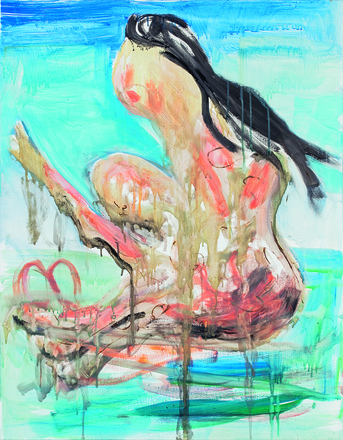
Albert Oehlen
Badende (2026)
Vertical streaks of paint run like melting makeup down the body of Albert Oehlen’s “Badende” (bather). The dynamic-looking figure is embedded in a turquoise background, likewise painted in a watery style, that brings to mind the luminous blue of the Mediterranean or the light of the Provence-Alpes-Côte d’Azur region. The association is no coincidence: For his bather, Oehlen picks up on a trope from the history of painting that numerous artists, from Paul Cézanne to Pablo Picasso, engaged with during their stays in the south of France. Cézanne’s bathers, in particular, were Bad Painting avant la lettre, as the exhibition of his work currently on view at the Fondation Beyeler illustrates: Rendered in a deliberately clumsy style and like geometrically organized volumes in space, they might almost be an anticipation of Cubism. Oehlen takes Cézanne’s disintegration of the body even further, so that his bather literally melts away. Meanwhile, she raises an arm as if to issue a warning.Also noteworthy is that Oehlen works with proxies for flesh tones, such as ocher and orange. No classical carnation, it appears, is required to evoke physical associations and create the effect of vitality. The hair, billowing as though to replicate a Warburgian pathos formula, is another element breathing life into the figure. Yet if Oehlen’s “Badende” is steeped in the history of painting, his figure appears to be trying with her irreverent gestures to wash this heritage off her body like ballast. On the one hand, Oehlen stages a kind of painterly unconcern with traditional art historical genres; on the other hand, he brings them back for a captivating and entertaining encore.