
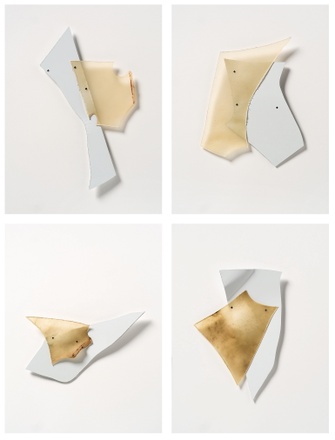
Thilo Heinzmann
Aicmo (2026)
Thilo Heinzmann’s works are characterized by an openness to new materials, techniques, and pictorial possibilities, on the one hand, and by a lucid artistic vision and its exacting implementation, on the other. Since the mid-1990s, Heinzmann has devised a painterly language that aims to expand the capacities of his artworks’ formative elements – ground, paint, and the texture produced by their interplay – in order to uncover novel potentials in painting. Besides canvas, he also works on polystyrene and chipboard, while color is broken down into its components – pigment and light – and applied using various techniques to wood as well as to other materials not typically associated with painting.An expansion of the pictorial space is also evident in Heinzmann’s anniversary edition for TEXTE ZUR KUNST, which is connected to a series of works of the same title, “Aicmo,” that he has developed since 2006. The irregularly shaped support medium – the artist has cut and bent the shaped canvases of these 35 unique works by hand – projects from the wall, which is in turn transformed into a painting surface in its own right by the shadows that the object casts. Pieces of parchment are attached to the industrially manufactured aluminum, their mottled colors and surface structure contrasting with the opaque white. The cultural context of parchment – one of the oldest support media for paintings – and the fact that it reacts sensitively to changes in its environment exemplify the delicate balance that Heinzmann’s oeuvre maintains: Intertwining conceptual reflections and considerations of the aesthetics of perception, it unfolds the sensual range of the beholder’s relation to painting.