In her recent letter to Bruce Hainley, Annette Weisser lamented the current wave of AI-slop and its role in normalizing fascism, while also reflecting on the challenges of raising a teenage son at a time when misogyny seems to be fully back in trend among many young men. In his response, Hainley picks up where Weisser left off, extolling the need for ambiguity in a world in which the information we provide is instrumentalized and the information offered to us usually serves an ulterior purpose. While Hainley sees little evidence of such complexity in Paul Thomas Anderson’s latest film, he finds relief in Larry Johnson’s current exhibition in Cologne, which takes a multilayered and nuanced approach to interartistic dialogue and Hollywood’s hidden gay history.
Dear Annette,
Jumping right in on this too-warm “winter” day – an almost humid 75 degrees (23.8 C) – that leaves me somewhat out of sorts, as one who enjoys winter, not only snow but cold (two weekends ago in New York it was around 10 degrees [-12.2 C], but no wind, with clarifying hibernal sunshine that makes chill splendid, revivifying).
As to the pleasure you find in an “abundance of visual information that doesn’t convey a clear message but is simply there,” I wonder if no small part of it is abreactive, due to the way we live now, with every bit of daily digitized visual information conveying a message and that message selling something to us, a sales force synchronized to every key stroke and search, blinking at the side of online articles, data-scraped from every swipe, and then again from our texting and phone conversations, when we bother to talk on the phone anymore. I loathe the “memories” or “for you” features on Apple products, vomiting up pictures, sometimes entire slideshows, that I didn’t want to see and that I’m not sure qualify as “memories.”
Yes, an older, pre-digital cinema and movie-making – and it’s hard not to romanticize it, despite all the inequities it helped entrench – did have an indexical relationship to what was on screen. The wind moving through the trees was an actual wind, and it might not mean anything in itself (which nevertheless can produce a kind of meaningfulness, that the world existed, exists, might still). I’m not sure what Paul Thomas Anderson was trying to sell us in One Battle After Another. I’m a fan of his movies, some of them quite a bit, but I really had so many problems with it – the cartooning of Angela Davis or someone Angela Davis–adjacent, the cartooning of revolutionary and/or militant politics and resistance. Col. Lockjaw!?! He isn’t to be gassed to death – that blowhard’s already been promoted, he’s commanding immigration raids right now! Sexual kinks never deterred right-wing politics. I mean, look at Roy Cohn, whose oily ghost still holds sway in the Oval Office. Barftime. But Benicio del Toro taking charge with his skater guerillas, and aging Leonardo DiCaprio putzing around, stoned, doughy, a mess and yet still less ineffectual than the Democrats – wonderful. Put that on a loop.
I was surprised, given his usually nimble mind, that PTA didn’t pick up the long-ago call – well, actually not that long ago given the moment (and its aftermaths) his film purports to spring from – placed by Jean-Luc Godard. “Que faire?” JLG asked the readers of Afterimage No. 1, April 1970:
1. Il faut faire des films politiques.
2. Il faut faire politiquement des films.
3. 1 et 2 sont antagonistes, et appartiennent à deux conceptions du monde opposées.
I’m not sure with One Battle that PTA knows how to respond to Godard’s question of what to do – to the necessity to make political films or to make films politically. One Battle is a film about some kind of politics, but I’m not convinced it’s a political film, and it’s definitely not a film made politically. No dialectic, no bringing together two opposing conceptions of the world. Whatever. It’s better than so many other things and it gives me reason to groove again on numbers 23, 24, and 25 of Godard’s fierce directive (as Mo Teitelbaum first translated it):
23. To carry out 1 is to say how things are real. (Brecht)
24. To carry out 2 is to say how things really are. (Brecht)
25. To carry out 2 is to edit a film before shooting it, to make it during filming and to make it after the filming. (Dziga Vertov)
So much of this unambiguousness – an absolute immunity from doubt, from thinking, from care, from responsibility (its visual complement the so-called hyperrealism of AI slop-rot) – is not only “seeping into every aspect of image production” but also polluting how artists situate their own enterprises. What a rancid sort of privilege, living without doubt. I attended a talk in which the utterly tedious work on the screen, the artist stated, responded to the carceral system, border politics, labor inequities, family drama, blah blah blah. What wasn’t it about? The artist never dared to venture what their work might do, too concerned with just wanting to pacify any doubt, any ambiguity, any obstinate, taciturn refusal by positioning the so-called art to function in exactly the way they thought the audience would want them to have art function. It was exasperating and sad.
With your attention to more than mere yearning for the haecceity of the world, for pictures that engage its obliqueness (akin in some ways to Amelie von Wulffen’s “poodle skin” or, as you remind me, devilish “poodle essence” meditations), in no way an urge for cultural production to not face the moment in all of its complexity – dialectically, dialogically, alert to double consciousness and alive to opacity – your letter zapped me back to Larry Johnson’s current show at Galerie Buchholz in Köln. I wrote a text to accompany the new work, and yet I find myself still thinking about it enough to want to trouble and/or expand on what I wrote. It’s not that what I wrote was wrong or failed (I don’t know, maybe it did), but I tire of moving on when an artist’s work still sticks in my head, especially when so much contemporary art just doesn’t.
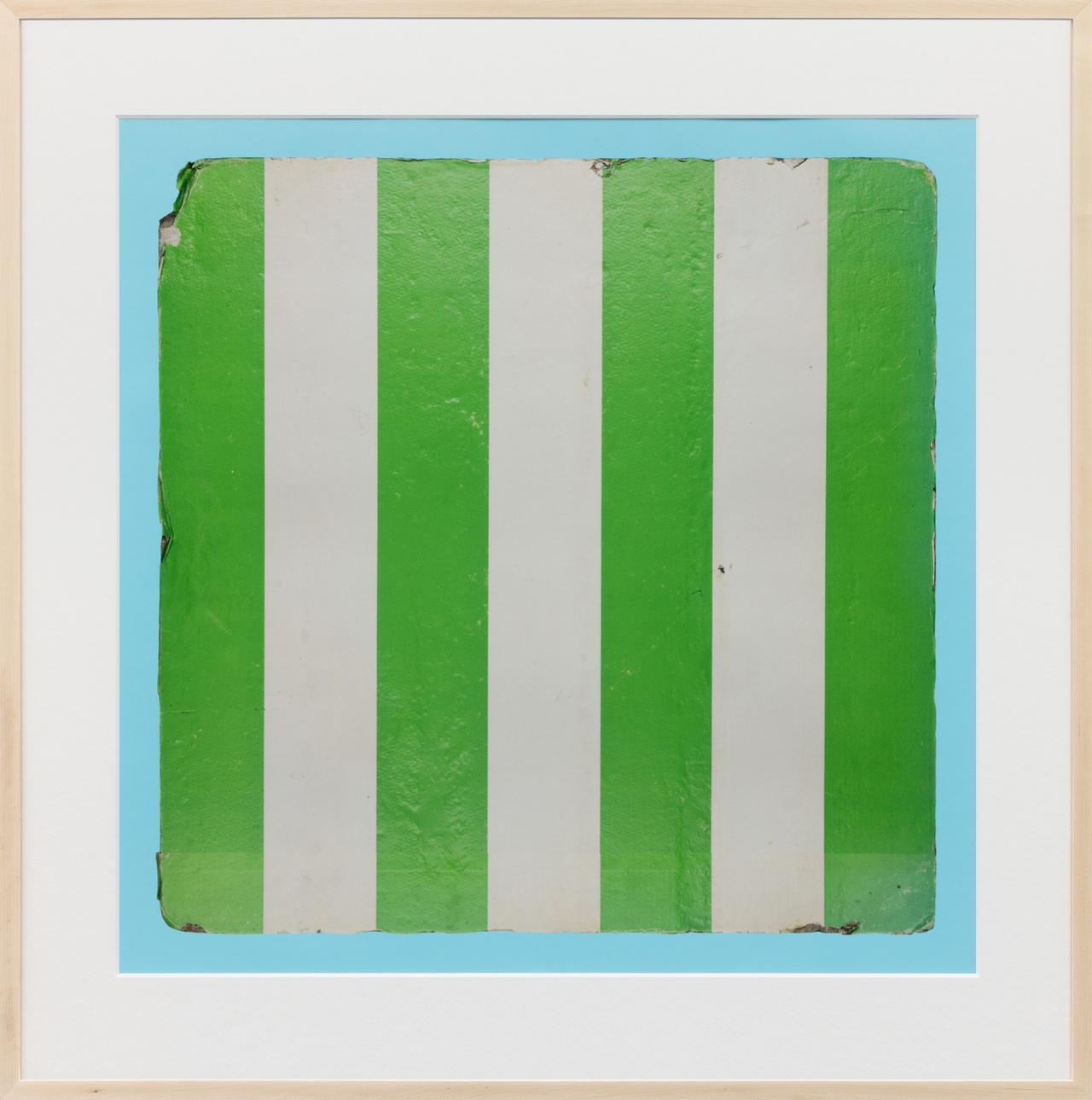
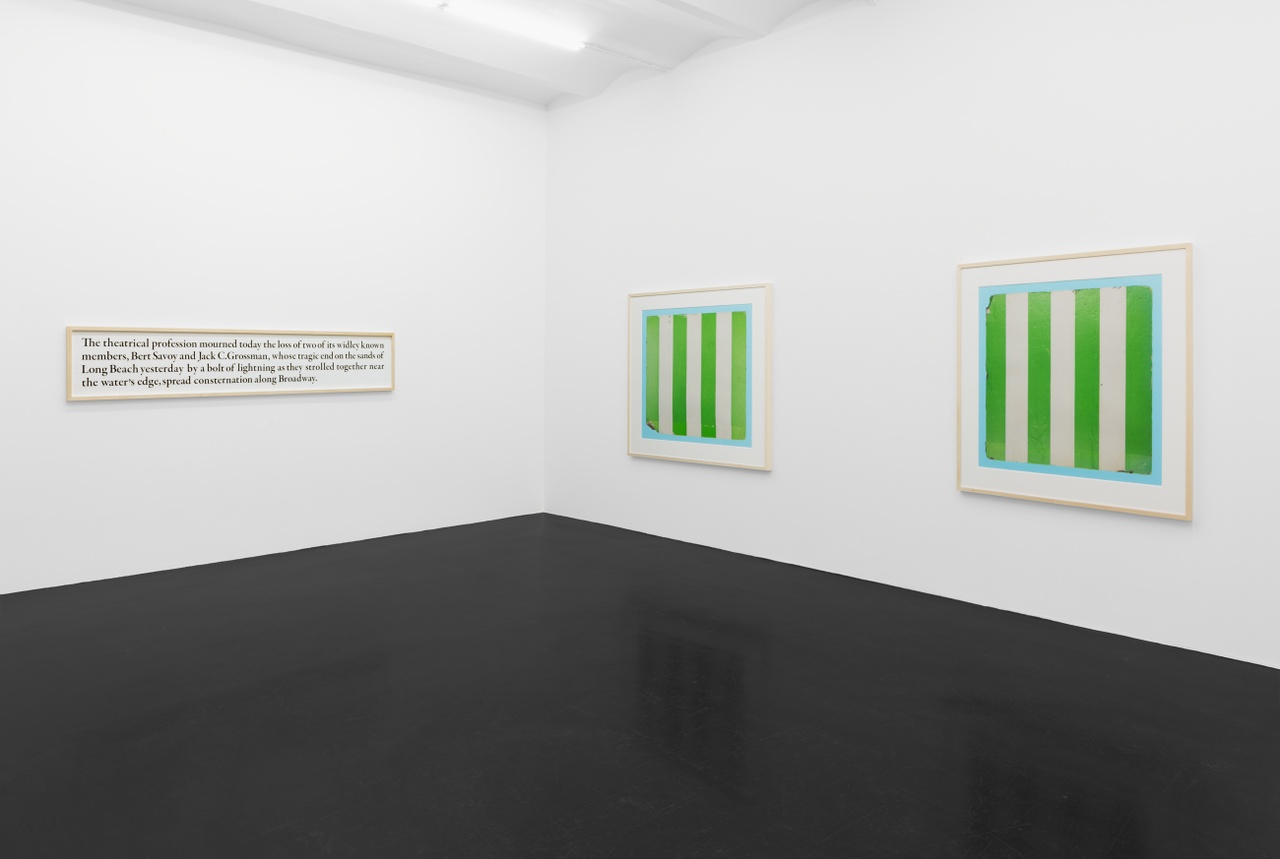
His show was made up of three elements: an invitation card with a picture of a sun-kissed Kodachrome candid of Montgomery Clift, shirtless, on Fire Island; text works concerning butchfemmera, as Larry sometimes refers to it – fleeting, seaside, tragic anecdotes of early Hollywood or Hollywood-adjacent queer life, relayed in printed paper, rubber cement, pencil, on museum board, procedures that refer back to his days as a paste-up artist as well as to Sherrie Levine’s just pre-rephotography collages; and four vivid archival inkjet prints, one for each of the remaining green-and-white striped panels – Larry calls them “Cabana[s]” – from Daniel Buren’s “Frost and Defrost: A Work in Situ” (1979) at Otis Art Institute Gallery, the gallery of an early iteration of the college where Larry still teaches. (In 1965, Charles White was hired at Otis, the first black member of the art faculty, soon teaching David Hammons and Suzanne Jackson, among others – but that’s an itinerary for another time.) Your yearning for visual information with no clear message reminded me how much I do really love looking at things and thinking about them, trying to relate that thinking into words, no matter how much time it takes to find the language for art that’s worth the name, the recalcitrance of language meeting the recalcitrance of pictures, vice versa. I yearn for art that isn’t unambiguous, isn’t casually referring, and isn’t unaware of aspects of picture-making that elude immediate “meaning” but which is still, somehow, point-blank, punning, semiotically plush, and – given our ongoing do-si-do with masculinity, masculinities – somehow astringent and apotropaic.
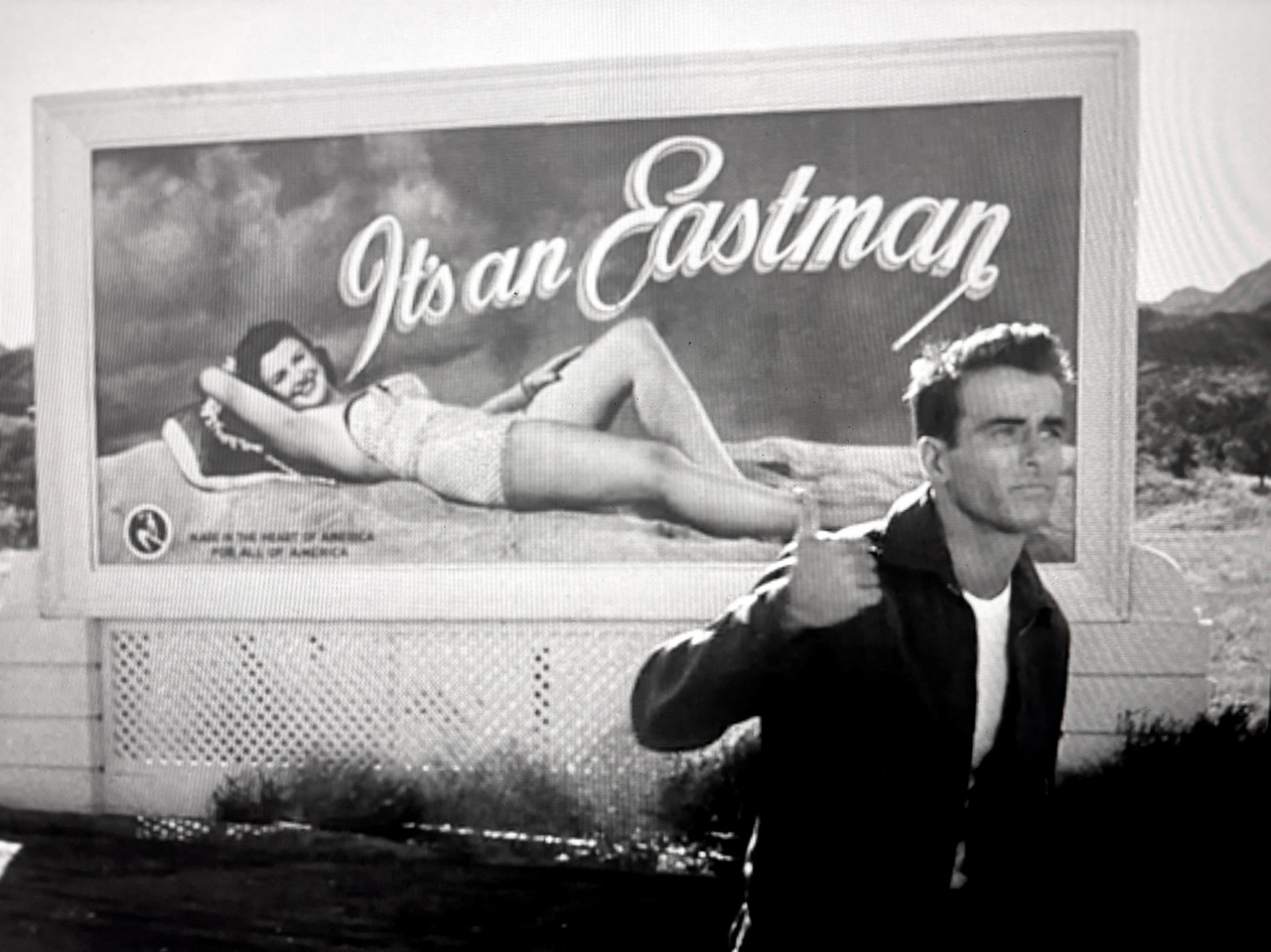
Cut to: a handsome young man, somewhat forlorn or concerned, hitchhiking, his hitchhiking and forlornness and handsomeness in a bomber jacket, startling white T-shirt, and workman’s pants inhabited by Montgomery Clift. Behind him, a billboard from which a beauty in a bathing suit smiles. She could be a budget Elizabeth Taylor. Arcing above the Buckeye odalisque, an exclamation: “It’s an Eastman!” Rewatching the start of A Place in the Sun, I thought, Oh, funny, an advertisement for Eastman Kodak – the billboard and its paradoxically vivid color, despite being black-and-white, brought to us by a film company. But no, or not quite (yet). Within the diegetic parameters, the Eastman refers to George Eastman, bathing suit manufacturer, tycoon, and his merchandise, but the billboard itself hails the hitchhiker, “it” and not “he,” as an Eastman, too: a family as well as filmic relation, apparition. George Stevens’s tragedy will play off the disorienting beauty of Montgomery Clift and Elizabeth Taylor: his femme/bottom deliberation, her butch/top bossiness; Monty’s clit, Liz’s dick. Of course, like that billboard, these various cinematic George Eastmans also hail that other George Eastman, extradiegetically, entrepreneur and founder of the Eastman Kodak Company, a lifelong bachelor who doted on his mother and loved to play the piano. Doesn’t he countersign, in no minor materialist way, almost every Hollywood movie in its mid-20th-century heyday?
Kodak’s innovative technology allowed pictures to be made by and circulated among the masses. With his vast wealth, George Eastman donated to, among other things, many educational institutions, established the Eastman School of Music, and was, for years, the largest donor to both the Hampton and Tuskegee Institutes, historically black universities – all of that philanthropy and music, and yet Eastman remained a staunch segregationist, even donating money to eugenics causes. Kodak hired almost no black employees during its founder’s lifetime. (I was going to put this entire paragraph in parentheses, but it doesn’t seem an afterthought.)
The picture of Monty in flaming color on Fire Island used for the announcement card is itself a critical displacement as well as a sign for how displacement operates in Larry’s new work. The vivid color of the card’s picture engages the black and white of both A Place in the Sun and Suddenly, Last Summer, the only two black-and-white films starring both Clift and Taylor. (My friend Siobhan said she was startled to see the candid of Monty for Larry’s show because she only ever thought about him as a movie star in Eastman Kodak black and white.) Raintree County, the third film the two starred in together, was in color. A baroque farrago about the Civil War, abolition, and miscegenation, Raintree County, made between the other two films, dramatizes a civil war played out on Clift’s face (the actor was in a car accident during the middle of the shoot, delaying filming) and between his on-screen and off-screen existences.
A commentary on what color as color and/or “candidness” would and would not be allowed to convey – let Monty function as a figure for mid-20th-century photography, all its possibility, but also its part in maintaining various kinds of mainstream narratives refusing to depict, eliding what and who was excluded, excised, from such national storytelling. By keeping the three elements of the show discrete, Larry cuts and sutures into place a dialectic, a politics of difference and displacement, the consequences of both Hollywood studio-enforced discretion and variegated sexual flamboyance that predates it.
Monty’s heartbreaking smile announces a show without any faces, where the photographic is broken down into its constitutive parts – what is produced by light (photo) and what is produced by writing (graph) – at a moment in which it is assumed that images subsume and/or overwhelm the written, without considering the algorithmic coding that produces the barrage of visual information in contemporary existence. The “Cabana” works are a de-facement (their color hailing the color of Fire Island Monty but not the face or body; his visage un- or dis-figured by or in the Buren stripes, depicting art stripped down to signing and not to its maker). Larry translates the critique of painting fundamental to Buren’s early work to the photographic, retaining a critique of picture-making, which the text-based paste-ups, collages, respond to, antipictorially, while also operating as displaced captions, biographemes of historical gay and trans performers.
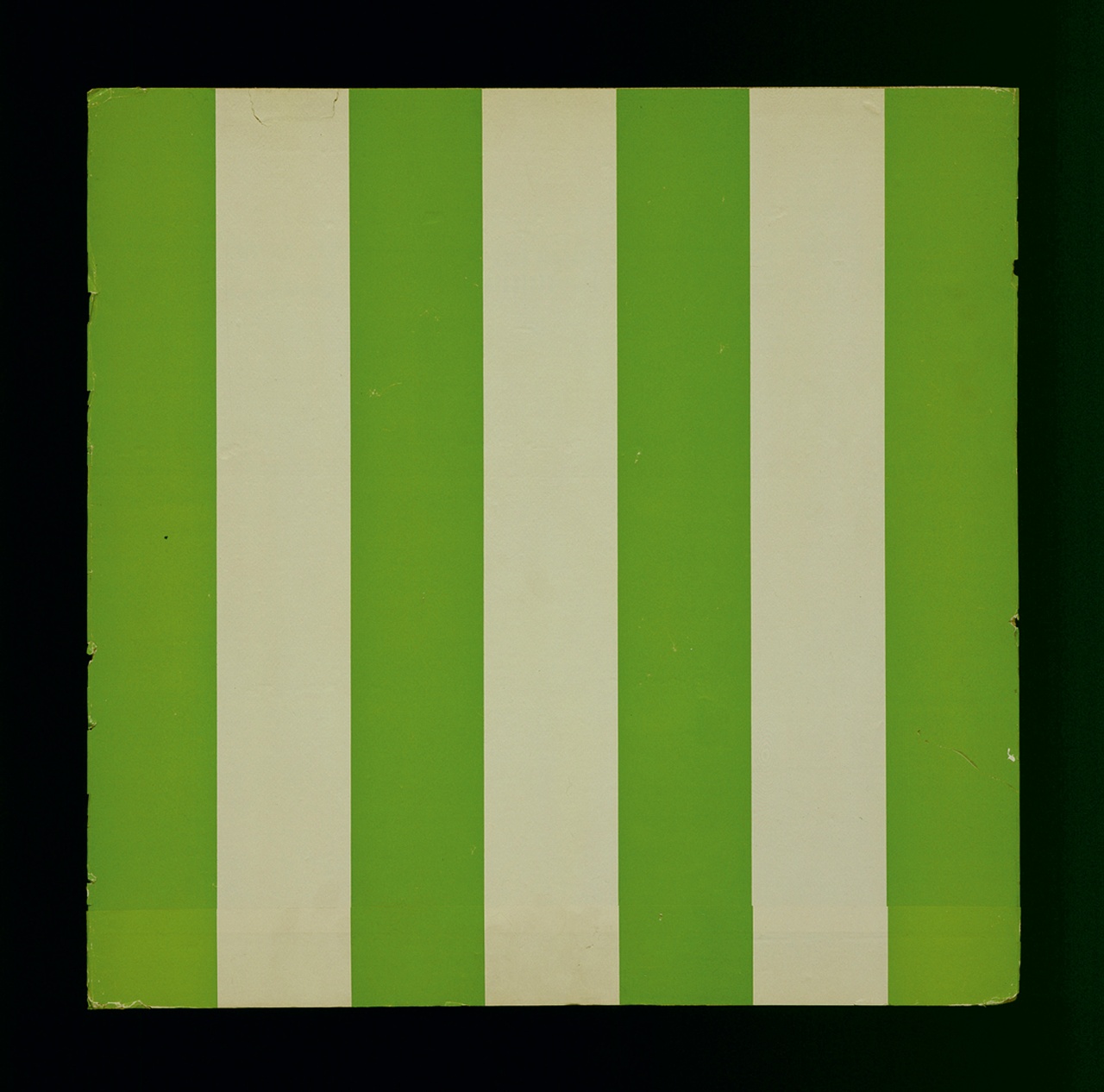
Only after I’d finished the text on Larry’s new work was I nudged, or did I figure out or recall, that Larry’s Untitled (Cabana[s] 1–4) respond to a photograph made by Christopher Williams 20 years ago of a Buren panel that Larry had given him.
One of 406 Ceiling Panels
(23 ¾ x 23 ¾ inches each)
Covered on the back with striped paper
(green and white)
Each Stripe is 8.7 cm.
From “Frost and Defrost: A Work in Situ
By Daniel Buren”
Otis Art Institute Gallery, 2401 Wilshire
Boulevard, Los Angeles, California
January 28 - March 4, 1979
Hal Glicksman, Gallery Director;
Christopher D’Arcangelo, Assistant to
Daniel Buren
Photography by the Douglas M. Parker
Studio, Glendale, California
May 4, 2006
2006
Chromogenic print
Paper: 91.4 x 76 cm (36 x 30 in.);
framed: 107 x 105.5 cm (42 ¼ x 41 ¼ in.)
When I wrote to Williams to apologize for missing this crucial backstory in my initial attempt to rally to Larry’s exhibition, he replied: “I put out signals wanting but not expecting a reply. Imagine that reply arrives some 20 years later in the form of this beautiful exhibition and by Larry to boot.”
Suddenly, this winter, Larry signals to Williams’s particular (memorial) picture as much as to his and Williams’s ongoing meditations on institutional memory, private language, and discourse, artists speaking to artists through art across time. Which isn’t to say that Larry’s show doesn’t also provide a retort to the various stupidities of this moment by invoking with pointed displacement – which isn’t the same thing as ambiguously – the title of the novel by Theodore Dreiser, An American Tragedy, that A Place in the Sun was based on: a tale, in part, about the extent to which certain men, whether because of class inequity or unthinking arrogance, desperation, and/or desire, will go to in order to get what they want. What they think they want. The movie is about all of that, but just as much, it’s about the ineffable, unlikely, untimely, tremoring beauty of Montgomery Clift that is simply there. Larry’s texts and pictures coordinate somehow something deeply emotional in response to it all.
I hope aspects of that visual information, simply there, the yearning for it, are still present in some of this reply: I’ve said nothing of the dings and damage of the Buren panels, said nothing about Larry’s decision to retain the misspellings already found in the texts he appropriates: “A few minutes after Jean Malin, entertainer and female impersonator, had stepped from a nightclub stage here, ending a farewell appearance which had been advertised as the ‘Last Night of Gene Malin,’ he was killed when his automobile plunged off an ocean pier.” They exist with no clear message, but not only no clear message. I’ve not rallied to all you’re going through, joy and worry and consternation, with Luis’s adolescence, his dreaming, cars, and transition from boyhood to early manhood. I’m not, sadly, Duncan Smith – his brilliant, peculiar book of essays, The Age of Oil, remains a touchstone – or I might have mixed a cocktail of gay and/or trans desire and existence from the auto-mobility of gender, the I-dreams of Djinn Jeannies as well as Jean Genet’s male tales of male tail in blue jeans.
Bruce Hainley lives in Houston, Texas.
Image credits: 1. screenshot by Bruce Hainley; 2 + 3. courtesy Galerie Buchholz; 4. courtesy the artist, Galerie Gisela Capitain, Cologne and David Zwirner Gallery, New York/London/Paris.
Note