
SPECTERS AT PLAY Tim Griffin on “What a Wonderful World: An Audiovisual Poem,” Julia Stoschek Foundation at the Variety Arts Theater, Los Angeles
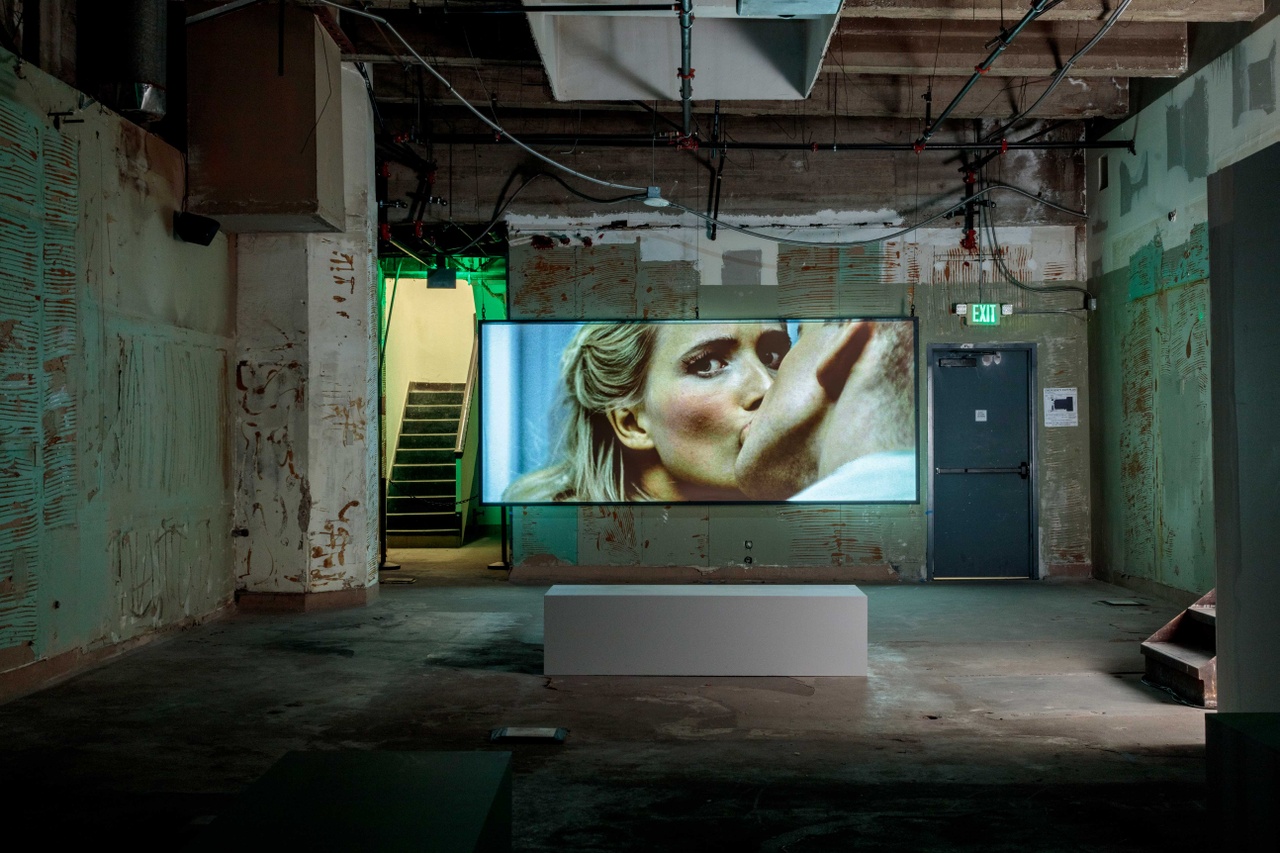
Jasper Just, “Something to Love”, 2005
By now, abandoning the conventional gallery context for disused architectures is a deeply familiar impulse in exhibition-making. [1] And why not? Such altered backdrops are all too alluring for powerfully bringing the world itself to the magical borders of theater, signaling not only the degree to which a drifting experience of media and woven narratives is built into our everyday lives but also – with the uncanny anticipation of science fiction – how our contemporary moment will, too, someday be just an alien figure of history. Given the precarity of postwar institutions in art and wider society, the model is especially easy to embrace, and even to relish. [2] It scratches the itch.
The Stoschek Foundation is hardly subject to such precarity, yet curator Udo Kittelmann’s “What a Wonderful World: An Audiovisual Poem” is stunning by virtue of its on-the-nose choice of subject and location: video works from the Julia Stoschek Collection set within the cavernous, warren-like, and dilapidated Variety Arts Theater in downtown Los Angeles. In an era when the modern museum-exhibition apparatus feels not always true to contemporary experience, walking into the Variety Arts Theater feels like one part archaeological dig, one part The Shining.
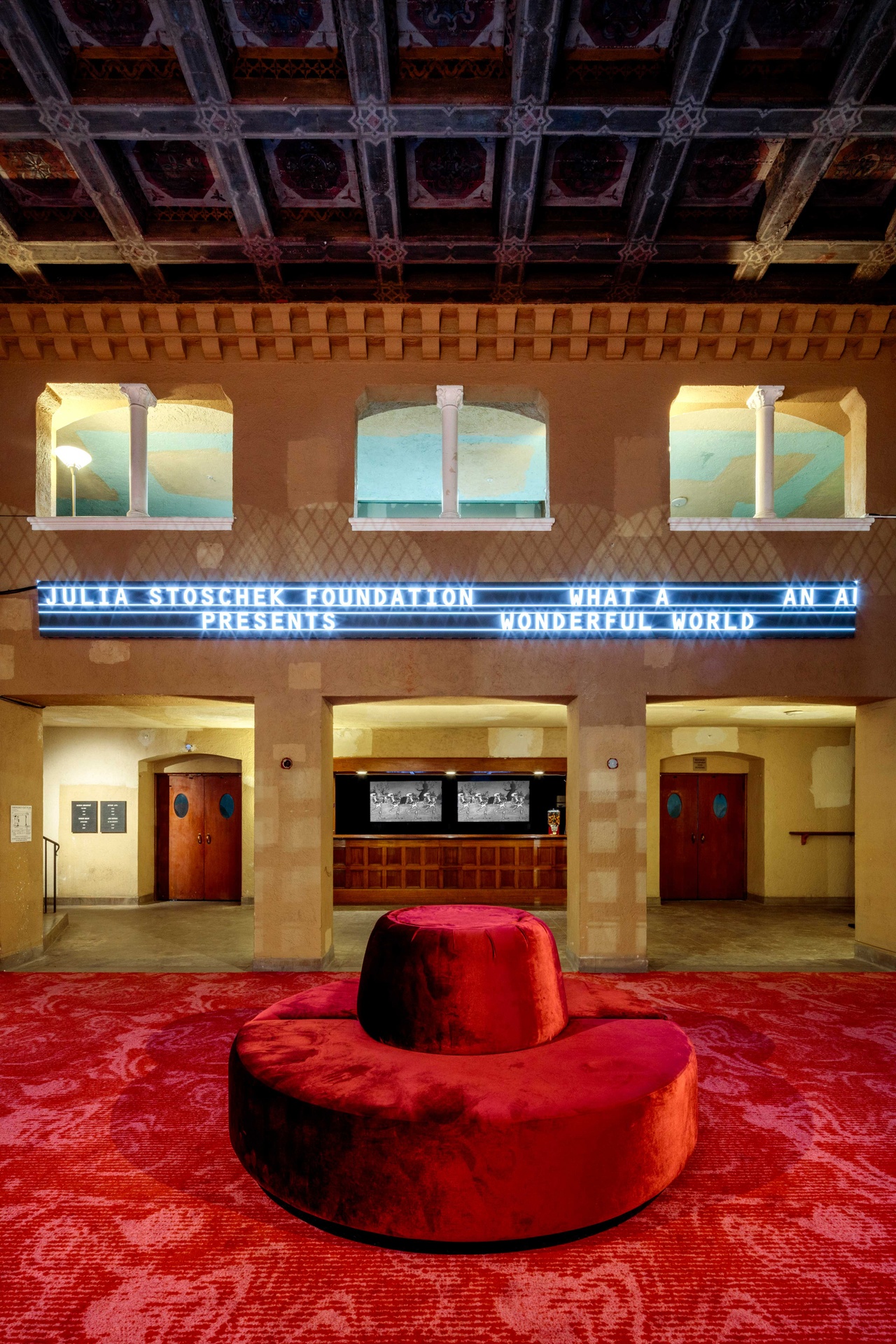
“What a Wonderful World: An Audiovisual Poem”, Stoschek Foundation at Variety Arts Theater, Los Angeles, 2026
While the past is palpable here in every wall of the 1920s building, which after its opening as a six-floor women’s club has hosted entertainers from Charlie Chaplin to Hüsker Dü, the dramatic scale of empty theater spaces and back rooms most animates a sense of absence: of missing crowds whose place is taken here by so many screens. On first impression, this displacement seems laden with precise irony. If we reside in a moment of schismatic tension between still-standing physical architectures designed for collective experience and media platforms cultivating solo and siloed viewership, what better genre to reconsider today than video art? Its very emergence and stature in postwar art is indebted to interrogations of subjectivity, technology, space, and ways of seeing (and being) both individually and collectively. Any thoughtful survey of the medium should be uniquely poised to set the intense contradictions of our lived experience in high relief.
Before long, however, any such intellectual summation is too cool in its approach. Particularly given how “What a Wonderful World” opened this winter contemporaneously with such flagship studio films as Wuthering Heights reportedly screened to mere handfuls of audience members at Hollywood’s Chinese Theater. The theater itself no longer makes sense as a site of collective experience. Thus, in other words, any “absence” felt in the Variety Arts spaces would be wrongly set at any historical distance by art audiences wandering those rooms. While we are ostensibly looking at the past in “What a Wonderful World” – through the prism of a collection, and in the context of an abandoned theater venue – we are, in fact, looking at ourselves. What seems the past here is only our spectral present.
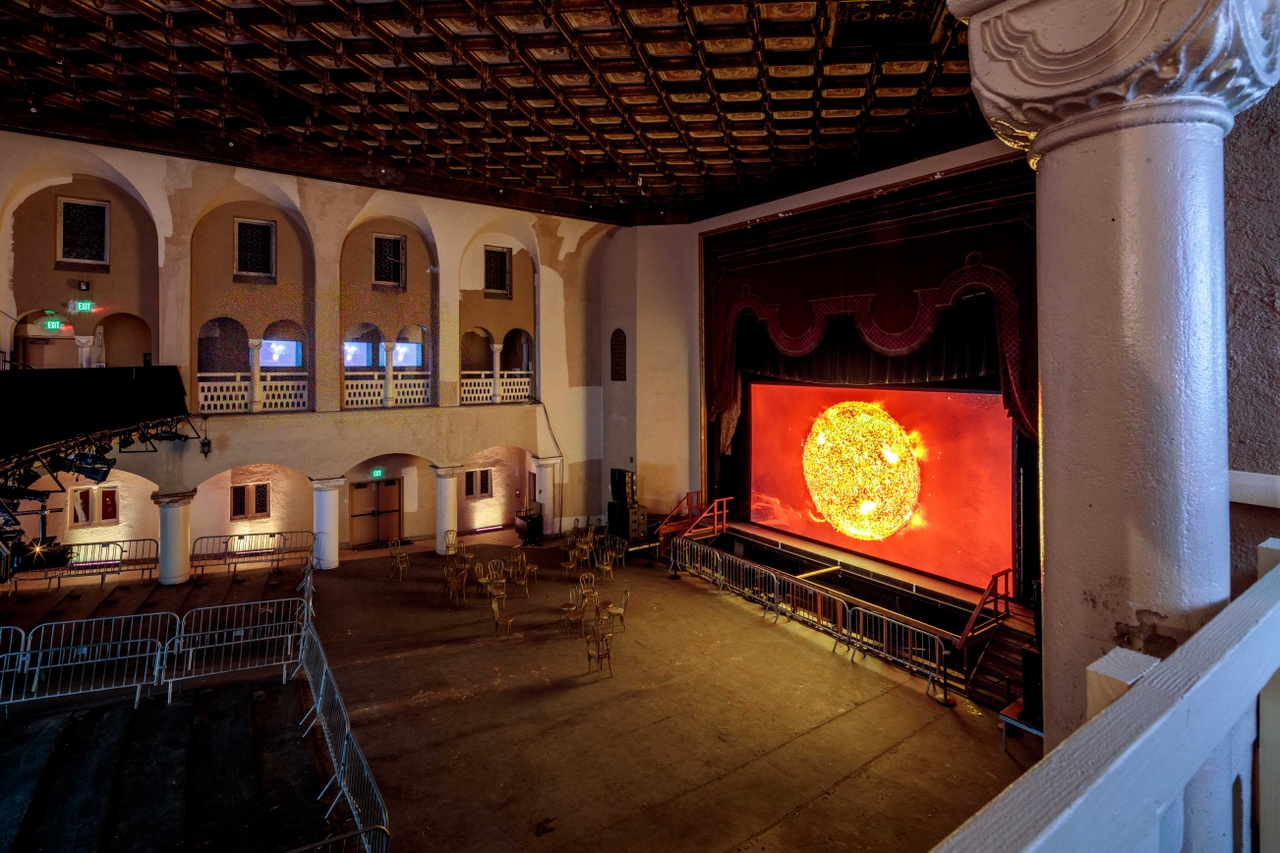
Arthur Jafa, “Apex”, 2013
The theater lobby suggests Kittelmann believes as much, with Walt Disney’s The Skeleton Dance (1929) immediately appearing as a keynote behind the main reception desk. The short film – a latter-day memento mori, in the curator’s own words – features human skeletons dancing through the landscape of a nighttime cemetery, establishing an implicit equivalence between the animated, moving image and the apparitional. In the same spirit, numerous videos from Stoschek’s collection are given over to “animating” specific spaces through thematic rhymes.
In the basement, Wu Tsang’s Wildness (2012) – a documentary about Silver Platter, one of the oldest LGBTQ+ bars in Los Angeles – is installed in a defunct dressing room whose setting amplifies questions of visibility, self-identification, and performance. Not far away, Douglas Gordon’s The Making of Monster (1996) is displayed in a bathroom that seems a physical extension of what appears onscreen, where the artist stands before a sink’s mirror, distorting his appearance by stretching tape across his face. Above an abandoned balcony bar, Klara Lidén’s similarly stark Untitled (Trashcan) (2011) plays a jukebox-worthy, forlorn track by Patti Smith. And in the backroom area of another floor, Jesper Just’s Something to Love (2005) depicts a man’s course through a labyrinthine subway architecture to discover an amorous couple – a narrative that doubles “Wonderful World” viewers’ movements through the Variety Theater’s spaces to discover this work in an area where, back in the building’s clubbing days, exactly such scenes were probably found.
Frequently, historical counterpoints are created among pieces, which further dial up such strange echoes and a compressed sense of time. For example, Cyprien Gaillard’s 16mm film Cities of Gold and Mirrors (2009) neatly appears alongside Maya Deren’s Meditation on Violence (1948). The latter distills movements from Wu Tang and Shaolin martial arts, while the former comprises a dense, kaleidoscopic array of acculturated motions and behaviors – from tai chi to fraternity-house drinking rituals – against the backdrop of ancient Mayan and modern architectures in Cancún. An accompanying electronic soundtrack from the early 1980s wafts throughout the nearby Variety spaces to imbue them with a science-fictional atmosphere as well. Similar rhymes arise when a piece like Luis Buñuel and Salvador Dali’s Un chien andalou (1929), with its sliced eye and disorienting edits echoing that day’s political landscape in transition, resides in the basement’s “subconscious,” not far from Sigalit Landau’s Barbed Hula (2000), for which the artist spins a hoop of barbed wire around her bare waist.
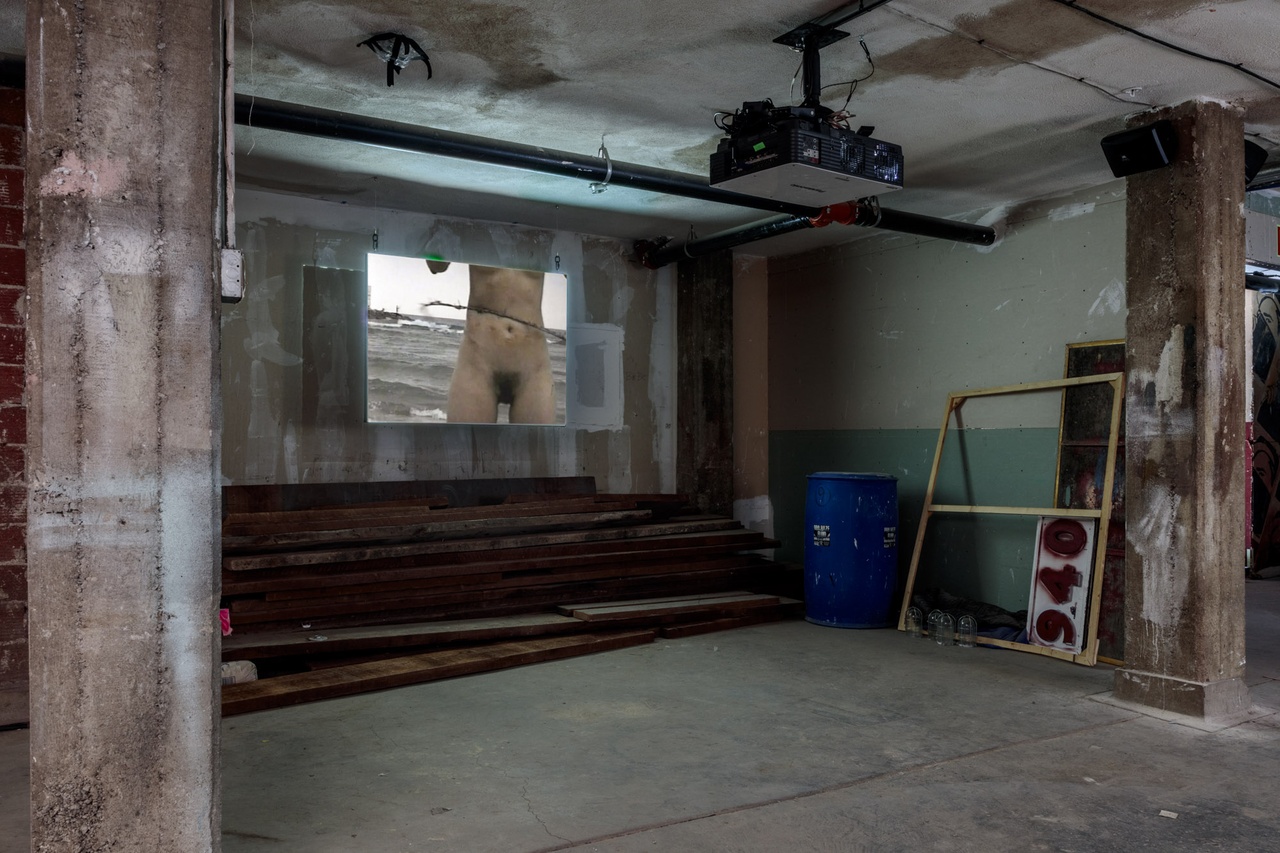
Sigalit Landau, “Barbed Hula”, 2000
In fact, charged correspondences between psychology and our own political landscape are pivotal for the experience of “What a Wonderful World,” especially when considering societal traumas steeped in the distance and dissonance between reality and representation. These are especially resonant questions in frequently gaslit times, and maybe the story within the story of this exhibition that has political echoes throughout. Even a staged installation for Travers Vale and George Cowl’s Betsy Ross (1917), named for the designer of the original US flag, is hallucinatory in this way: a Lynchian scene replete with blood-red curtains.
The proximity of pieces by Jordan Wolfson and Precious Okoyomon here is provocative. In Okoyomon’s installation It’s dissociating season (2019), a teddy bear recounts a traumatic experience with the police – with the hallucinatory images onscreen bespeaking deep regression and repression, to keep such memories at bay. In contrast, Wolfson’s Artists Friends Racists (2020) consists of a wall of spinning fans with micro-LEDs using 3D HYPERVSN technology to superimpose those words (along with “fear” and “anxiety”) intermittently on holographic images of cartoon rabbits, robots, and Wolfson’s own portrait. The sequences seem schizophrenic, suggesting a relationship between image and text that is subject to manic manipulability. Yet precisely the work’s relentless, saccharine unease – paired with its material ambiguity, which is both lo-fi and hi-fi – conveys our reality by mimicking the insistent, world-altering addictiveness of today’s online scrolling.
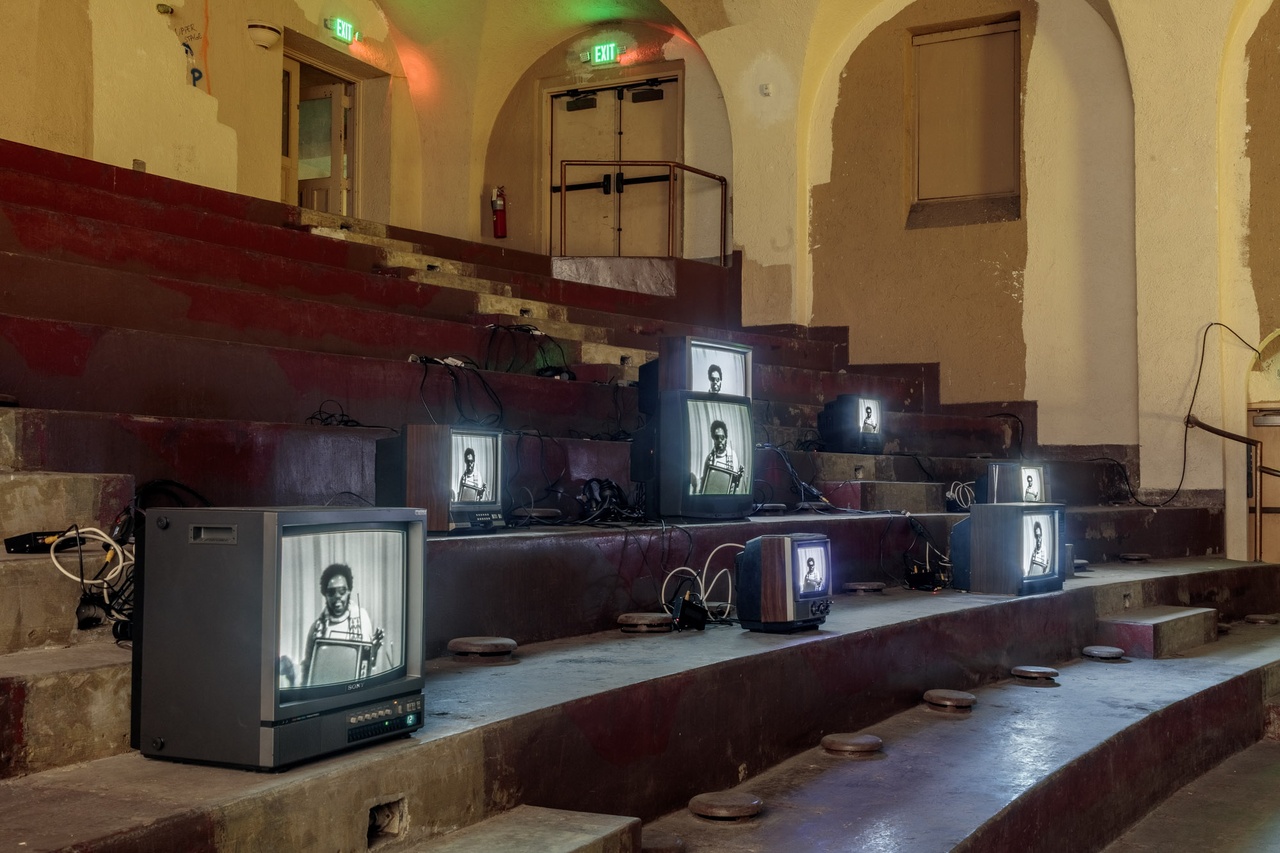
Ulysses Jenkins, “Mass of Images“, 1978
The psychological and political interweavings of “What a Wonderful World” are, however, best articulated in a swirling combination of works in the main proscenium theater that serves as the exhibition’s beginning and end. Viewers walking down a ramp to the hall’s empty floor are apt to encounter a grand projection of Jon Rafman’s Oh, the Humanity! (2015), a piece featuring a vast, brightly hued, pulsating field of people so blurred as to seem like a bleakly holographic, electronic image of everyone missing from the theater floor. This prospect of humanity being transposed into just so much information is echoed in the balcony above by Ulysses Jenkins’s Mass of Images (1978), where small monitors capture the artist defiantly repeating the phrase “You’re just a mass of images you’ve gotten to know, from years and years of TV shows.” And his words point back to Arthur Jafa’s Apex (2013), whose rapid-fire streaming of more than 800 found online images (projected onto the main screen after Rafman) capture what the artist calls the “power, beauty, and alienation of Black music.”
Set to a techno soundtrack by Robert Hood of Underground Resistance, Jafa’s inexorable sequence keeps pace with media-saturated attention spans, and its radical juxtapositions mirror the sensibility of an algorithmic search – never providing a sense of past or future within a comfortably narrative arc. Yet the work’s explosive potential is made palpable in its chorus with two other works in the balcony above, including Ana Mendieta’s Anima, Silueta de Cohetes (Firework Piece) (1976), which features a burning female silhouette in the desert landscape of Oaxaca, Mexico, and a pirated music video featuring a 1965 recording of Nina Simone singing Sinnerman, an African American spiritual, interspersed with an intermingling of historical documentary and fictional images capturing political violence and racism woven into United States culture. [3] Again, here the past is not the past, but resides within our spectral present.
Such correspondences prompt one to ponder the feeling and effect of gatherings among people that took place over the course of the exhibition, whereby the Variety Arts Theater was animated not only by images but also by focused public programs – from Jafa debuting a film to Doug Aitken organizing a program with Mike D, in addition to performances organized by author Fiona Alison Duncan of Hard to Read (a self-described “social literary practice”). These transitory moments may yet yield potential as traditional, stable architectures give way – something apparent even as, shortly after the conclusion of “What a Wonderful World,” the Stoschek Foundation itself announced the shuttering of its Berlin doors on the other side of the globe.
“What a Wonderful World: An Audiovisual Poem,” Julia Stoschek Foundation at the Variety Arts Theater, Los Angeles, February 6 –March 20, 2026.
Tim Griffin is artistic and executive director of The Industry, Los Angeles.
Image credit: Courtesy of Julia Stoschek Foundation, photos Joshua White
Notes
| [1] | To give just a couple examples, there is Pierre Huyghe’s work for Skulptur Projekte Münster, After ALife Ahead, 2017, which was situated in an abandoned ice rink, and Nairy Baghramian and Maria Hassabi’s sculpture-and-performance piece Entre Deux Actes (Ménage à Quatre), 2019, for which the artists took up an abandoned Fifth Avenue townhouse in New York City. Even more recent is the 13th Berlin Biennale for Contemporary Art’s use of a former courthouse, and The Campus, in upstate New York. |
| [2] | A proposition here is that, when the world changes too swiftly to be normalized, it begins to seem representational. The exhibitionary context of disused architecture – akin to Henry James’s “[t]he presence before him was a presence” – is uniquely attuned to that experience. |
| [3] | Sinnerman (Nina Simone, 1965), YouTube video, edit by Sakis Han, 5′27″, b/w, sound. |