
BRUCE HAINLEY TO ANNETTE WEISSER Houston, May 8, 2026
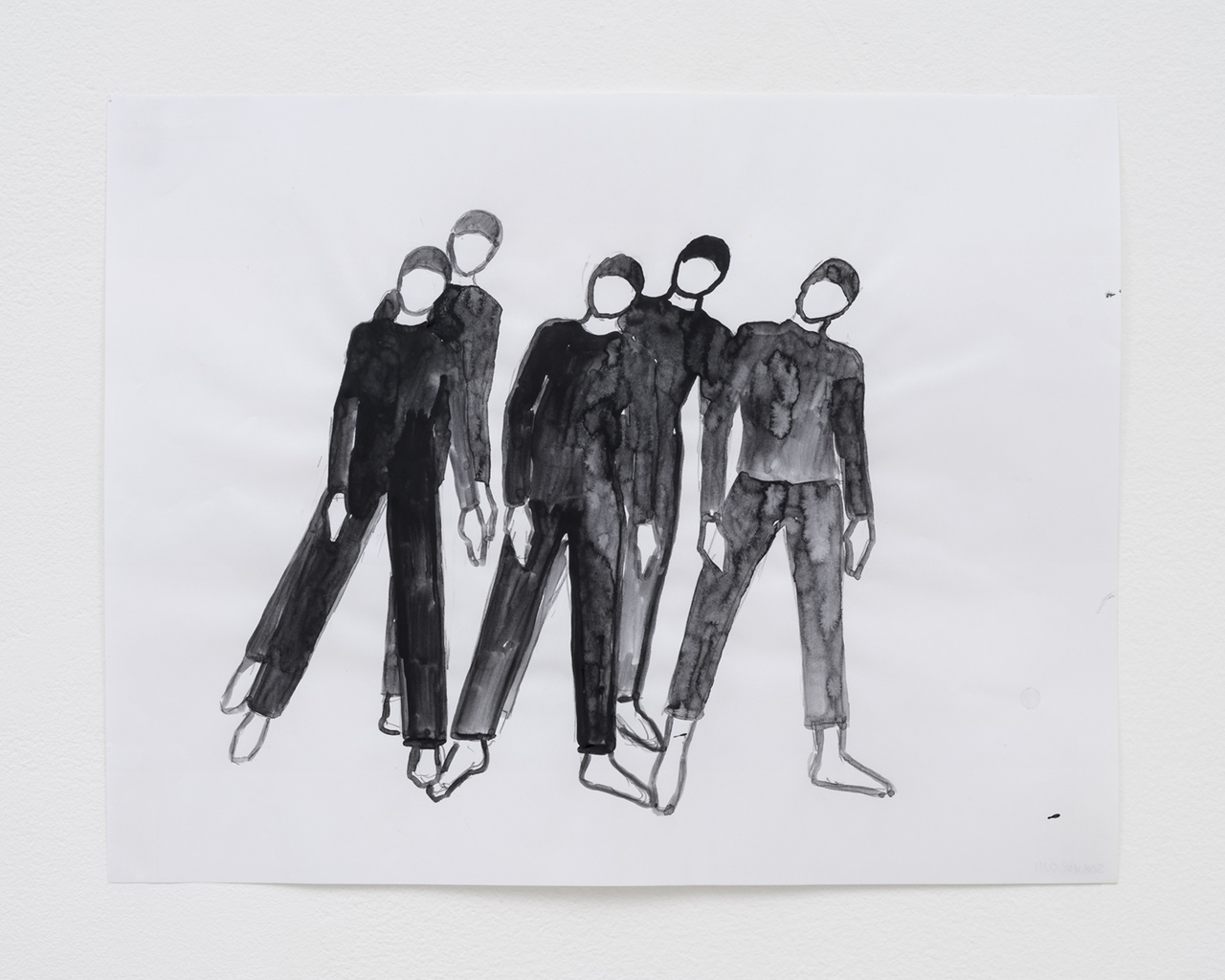
Silke Otto-Knapp, untitled, 2019
Bruce Hainley’s response to Annette Weisser’s last letter spans a surprising spectrum, from the absurd grandeur and vamped up villains of the latest Met Gala all the way to the subtle watercolor compositions of dancers by Silke Otto-Knapp, currently exhibited in LA. Can the latter – with their light graphic lines, gestural alignments, gradual transitions, and soft grisaille – serve as an effective counterpoint to the first? “Dance just to dance,” sings Aldous Harding in “Train on the Island,” which Hainley listens to while writing to Weisser. The figures in Otto-Knapp’s drawings certainly do.
Dear Annette,
Oh, the Met Gala, that grotesquerie of obliviousness, probably outgrossed (!) the business-as-usual of the Berlin art world, since it gilded its pointlessness by dressing up the obscenity of Amazon’s vicious business practices, the disgusting lucre of Jeff Bezos and his wife-contraption, as “charity” while its lousy attendees boogied for power-adjacency while vying for relevance and failing. Adorable that Madonna used her attendance to audition for the role of Bellatrix Lestrange, confusing Amazon for HBO. Protego horribilis!
Who has the most boots on their neck is not a contest anyone should ever want. Valerie Solanas thought daddy’s girls were as much a problem as men, although it was the masculine (or those who stand up for it) she thought needed cutting up most. Did she mean to complicate “care” as only good when taking aim at those women who care for, prop up, and exculpate bad men?
The way anyone accesses pornography, gay or otherwise, is now so radically, algorithmically distributed that I believe porn operates almost entirely differently than when I was your son’s age. Well, to begin with, when I was his age, I’m not sure I knew there was such a thing as gay pornography. Pornography, until social media, didn’t come to you, delivered due to the palm of your hand, whether you’re looking for it or not. Porn hadn’t been gamified. You had to seek it out, and even then, unless one lived in a metropolis, it could be very difficult to find. I had to figure out a way to traverse something like 35 to 40 miles from where I lived to any place that had even a meager selection of gay VHS tapes. Magazines were equally hard to find. I guess I got hard just imagining what might be contained within them once I knew they existed! This extreme (destructive) reversal, from seeking out to acquiescence (not sure that’s quite the term), has changed how anyone desires, has changed culture – utterly. The knowledge of what one might desire while not even understanding how that desire might be conveyed and/or commodified and/or articulated, that one desired at all, had to be self-constituted. The explicit image repertoire of homosexuality in the mainstream was meager.
When I figured out how to get to the mall, on a weekend my parents were out of town, I had money to rent a single videotape or buy a single magazine. Now, absolutely anywhere, on a phone, anyone can see more pornography of any type than one could ever actually consume or even try to quantify. Please don’t take this as bemoaning (however much I do believe something has been irrevocably altered, and not for the better) the givens (as this is the world we have and, often without consent or knowledge, have made), but it has affected almost all cultural production – and almost all reception.
I don’t believe a Richard Hawkins painting of the severed head of Adam Driver or a mutilated Biebs or AI Tiny Timmy Chalamet rotting from the inside are terribly different than seeing Caravaggio’s David with the Head of Goliath, a Hans Bellmer homunculus in the woods, or so many thrilling, brutal Hokusais.
I want to divert this debate before it hurtles into a cul-de-sac of misrecognition. Dennis Cooper’s écriture has nothing to do with any supposed “preferred” age of street hustlers: Not every man wanting to hire an escort loves young twinks or is, by a long shot, a pedophile. The phobia of gay men grooming children, or even being in proximity to children, has a noxious history. So I’ll let Avital Ronell reroute things a bit:
“In Rousseau the ass-whacking routinely known as “spanking” slaps together the first inscribed pages in memory – the child is being written upon. In Cooper, the ass, already a metonymic displacement of cock and face, circumscribes a trauma zone that gets marked by intrusive phenomena, unsettling flashbacks, and the instant replay that inhabit the work at hand. Read in its entirety, the corpus engages a theory of mourning – more exactly, of failed mourning and breached introjections that could be said to disclose the pathology we call America.
[...]
In [Cooper’s] work we consistently get a portrayal of the body without transcendence, sheer corpse, mangled and mutilated, which has yet to be rescued by the promise of release. I think that when I pick this up and rework it, I want to write on the becoming-corpse in [his] oeuvre, the sputtering epiphanies that occur in the undead moments of threadbare existence, the minute detachments that [he] trace[s] and convolute[s] in [his] incomparable way – it seems more like a … whatever, liminal, abyssal probe of destructive, um, jouissance.”
Some of what she’s so acutely thinking through applies to Richard’s work, too.
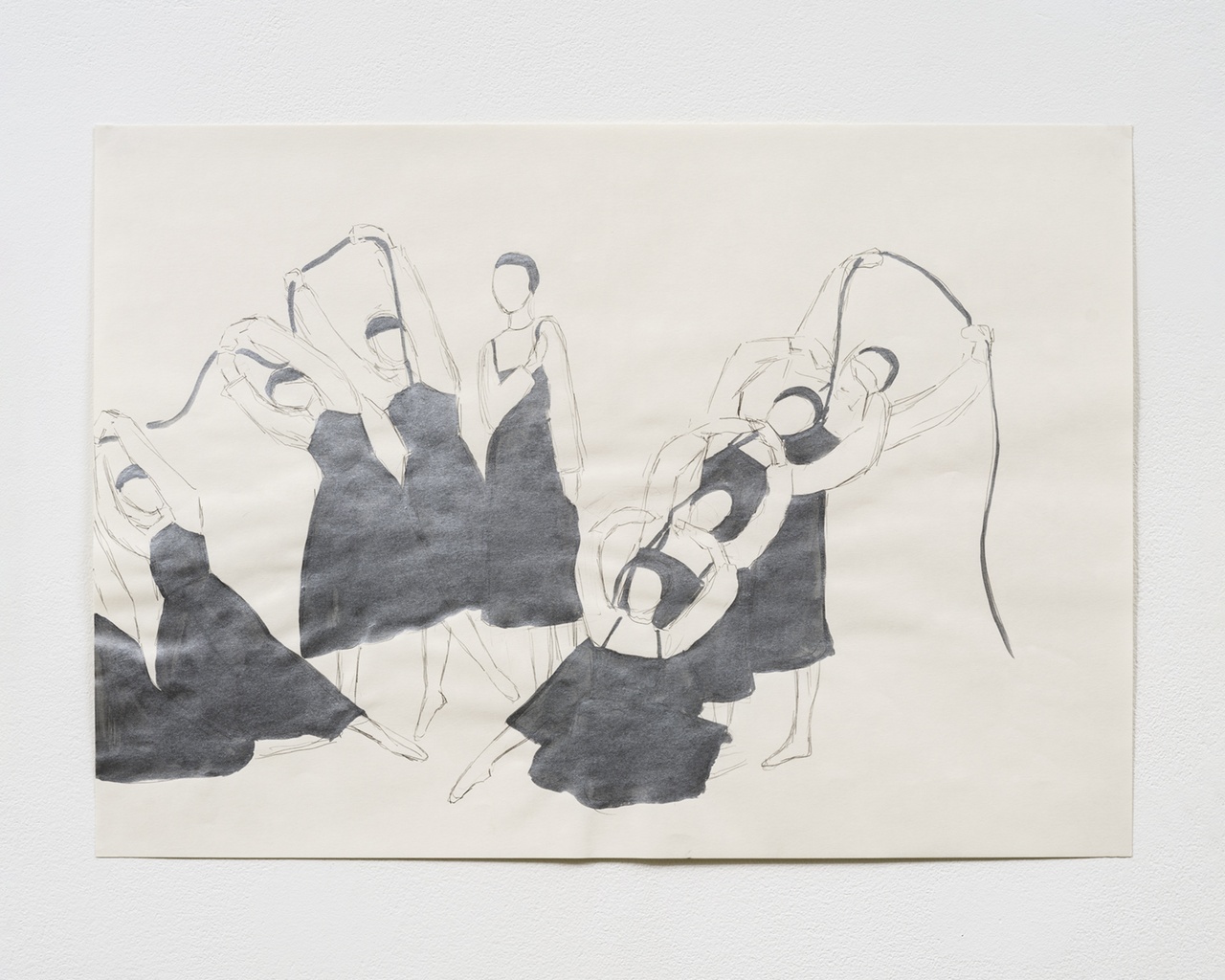
Silke Otto-Knapp, untitled, 2009
I told you I’ve been thinking about this show, organized by Kristina Kite, of never previously exhibited works on paper from 2007 to 2020 by Silke Otto-Knapp, paired with four Joan Jonas videos. When I walked into the gallery with my friend Christine, Darby English was talking, eloquently and excitedly, to a class of Fiona Connor’s graduate students.
I listened to Darby for a good 20 minutes or so, because whenever he speaks there will be something to learn. He was in the midst of saying something about how a lot of writing on Silke’s work discusses the assembled “community” in the work – and, if I’m recalling things correctly, that he didn’t know what that would mean or whether it was actually a “community” she was depicting, that he wasn’t sure what term one should use. I whispered to Christine, “Well, one operative term – in every sense of what it can mean – would be corps.” The flesh and the body in movement. A corps in unison and then breaking off into solo or pas de deux. The alignment and difference between a corps de ballet, a corps de troupe, and/or a corps d’elite – all of them somehow haunted by a uniformed schoolgirl assembly. Really, listening to Darby talk and seeing Silke’s companies of figures in black and white and some dazzlers in silver gouache and paint, always just at the moment of movement, and then missing her, her esprit de corps, I got very sad.
So let me turn away from becoming-corpse to becoming-corps, although they are deeply related, as bodies are finite – gravitybound, timebound, deathbound. Ah, but the exhilaration of watching dance live, dancers dancing as the best and surest sign of life, how they can approach the machinic when in precise accord, exact, exacting, and then disrupt that rhythmic togetherness with abandon, swerving into seemingly sheer impromptu. Corps could begin a discussion of the racial resonance of her pivot to black and white, her representational embodiments.
Silke loved dance and dancers and was thorough in seeing not just a performance when one of her favorite choreographers or troupes was in repertoire but every performance. When Michael Clark gave, with his company, one of his last presentations in London, she was in attendance every night, taking notes. The Jonas videos helped position Silke’s works on paper as dialogue, with all the differences (of opinion, of vantage, of memory) that an intimate conversation can accommodate.

Silke Otto-Knapp, untitled, 2020
Part of the difficulty Darby pointed to is thinking through how Silke parlayed her love of dance – its sets and attire (unitard to elaborate costume), its artifice and sweating musculature – into a way of painting and drawing that never merely reduced her inspiration to illustration or labanotation. Her work – was it its lightness? its stylistics? its watercolor dissolves? – could really rub people the wrong way. She choreographed bodified line and form into figures that tableau, gesturing to historical sources as much as scrambling or jettisoning them. In one series, trees or a theatrical set or backdrop of trees pantomime the arch angles and Constructivist poses going on elsewhere in groups of dancers, complicating how to understand the animate and inanimate species-ness. The reserved charm of her work has something to do with line – graphic line, outlines, and gestural alignment despite often dissolving edges between bodies – as well as her turn from soft harlequinades of variegation to an inky black and crepuscular white grisaille.
I know that I have not addressed your thinking about mothering in any of this. I don’t believe I can. I have never wanted children, although I love working with young people. Really, my students, they’re almost the only reason I can handle staying in Houston. I’ve become so reedlike as a teacher, bending to the exigencies of the moment. When I have hope about the world, it’s in their resilience and pragmatism. I asked one of my most brilliant graduating students what they were going to do this summer, and they got very excited. They learned of a fellowship offered by an international electricians union and are going to train to be an electrician while they figure out what it means to be an artist. Who wouldn’t want to have a double major in radical philosophy and art wire every new grid, domestic or otherwise?
It’s raining this morning. I’m listening to Aldous Harding’s new album Train on the Island. Beautiful, not despite the world but in some way because of its current direness.
xoxob
Bruce Hainley lives in Houston, Texas.
Image credit: Courtesy Kristina Kite gallery and Michael Benevento gallery, photos Ed Mumford